
One Year at Mustang Field
By Tony Caldwell, Founder and Chairman, The Caldwell Collection at Mustang Field
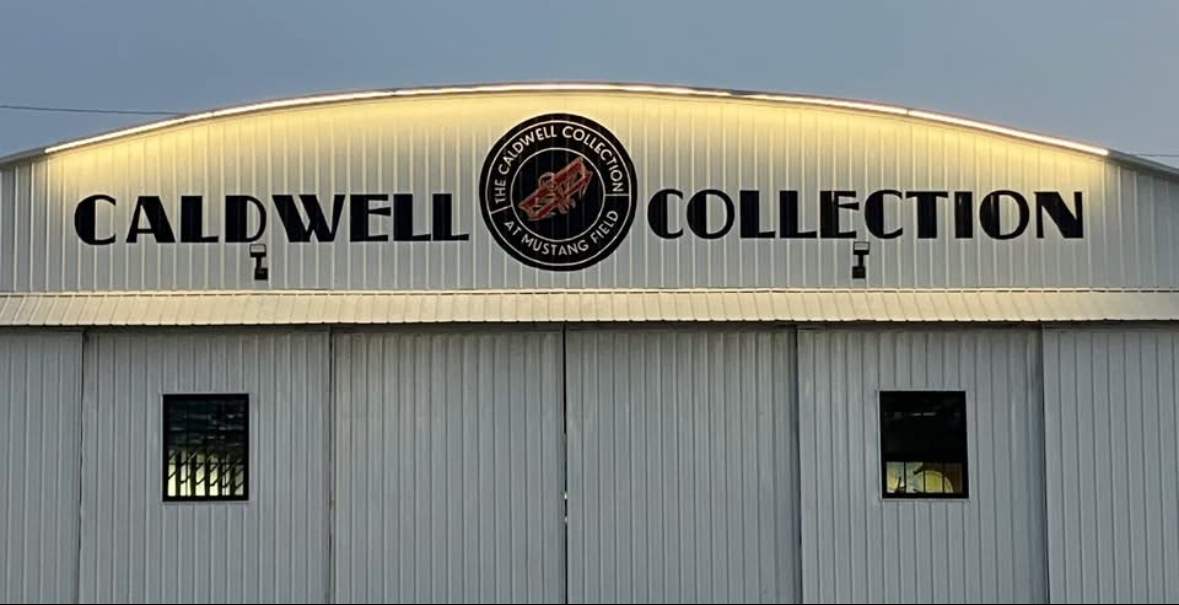
When I went to see Scott Law, the airport manager at El Reno Regional Airport, and Matt Sandidge, then the city manager, on that late October day in 2024, I went without much hope that we could find a way to agree on my building a hangar to house my antique aircraft collection. I was restoring a 1929 Travel Air with 30x5 wheels, and having read Richard Bach's book Biplane, I knew the danger of operating an airplane like that on concrete, especially in Oklahoma's gusty, unpredictable winds.
During that conversation, Matt mentioned that the City was preparing to tear down Hangars 3 and 1. I said I thought that was a real shame, because those hangars were their heritage. He asked whether I would be interested in one of them, and I said yes, potentially. The obvious choice for me was Hangar 1, because it was clearly in better condition, but it would not be available for a couple of years. So we walked down to look at Hangar 3, which was an absolute disaster. But after talking with my contractor friend David French, my family and my CPA, I decided not only to restore that hangar but the idea for a museum also began to take shape.
I had always been frustrated that at my old airport, no one but me got to see the beautiful antique airplanes I had collected, because of locked gates, fences and a generally difficult attitude toward visitors. I thought that in El Reno, where anyone can get in, people might feel free to wander by and take a look if the hangar doors were open. After a year of being open, that has happened more times than I can count. We have gone from opening by appointment to being open five days a week, but people still wander in when the hangar doors are open, and that leads to impromptu and delightful conversations about airplanes, flying, history and what we are doing here at the museum.
As we built the place, one of my goals became not just to build a hangar or a museum, but also a community: a place where pilots and people interested in aviation, particularly the aviation of the golden age between 1918 and 1942, could watch these airplanes fly or just hang out and enjoy being with other people who share their interests. That desire led us to add a place where hangar flying, as it is known, could be comfortable and fun, and so we built Wiley and Will's Hangar Flying Cafe into the museum.
When I first got seriously interested in aviation, I was probably ten years old. I spent a lot of time at the local library, just two blocks from my house, reading every magazine and book about flying I could get my hands on. I wanted to create a place where other people who spend their time and imagination in the clouds could do the same thing. So we added a library, which now has more than 2,000 volumes and a rich collection of magazines dating back to the earliest days of flying.
One of the things I have learned in my relatively short journey as a collector of antiques is that for some rare airplanes, if you want one, you have to rebuild and restore it. So from the very beginning of the idea of the museum, we included a restoration workshop. We recruited Rob Lock of Waldo Wright's Flying Service to bring his restoration shop to El Reno, to work not only on airplanes for the collection but on airplanes for his other clients as well, in a place where visitors could see the past taking shape in wood and fabric under his skilled hands. Today that shop always has between three and five airplanes in it, undergoing restoration and maintenance.
When we started restoring Hangar 3, I worried that my small collection of about a dozen airplanes might look lonely in such a cavernous space. I thought about parties I had been to where hundreds of people were in attendance, but the building was so large it looked as if nobody had come. I did not want that for the museum, and so we spent a lot of 2025 adding to the collection. When we opened, we had roughly twenty-four airplanes on display, as well as a few ground vehicles.
So what has happened since we opened?
First, the community I hoped would coalesce around this new museum has begun to form. Each Saturday, volunteers ranging in age from fourteen to eighty-five gather to talk shop, clean airplanes and entertain visitors, but most of all to enjoy themselves and each other and the new friendships they have formed. The group is never the same from week to week, and there are now several dozen people in our small but growing community, including many who have been coming to the airport for years and have a new place to hang out.
About 5,000 people have come through our doors, whether we were open, by appointment, or sometimes just because the hangar door was open. They have come from all over the country and much of the world. It has been gratifying to hear most of them say they found something at Mustang Field that was greater than what they expected. That tells me we are not only doing things well, but that we are on the right track as we build what we hope will be an institution that is not only here, but relevant, a hundred years from now.
My restless curiosity has not stopped, and I have continued to look for new old airplanes to add to our collection. In our first full year of operation, we have increased the collection from twenty-four airplanes to thirty-six, adding roughly one airplane a month. In a blog I wrote earlier this year, I wondered how people got to work when this place was a training field in World War II and you had only three gallons of gas a week. That question has led to a new collection of ground vehicles: the cars, motorcycles, bicycles and other ways people got to this place, other than on foot, during the war years.
As we opened and began to greet guests, it became increasingly obvious to me that the 30,000 square feet I had once thought was gigantic for our needs was not going to be adequate. While we were building, the City had gone on with its plans for the other hangar Matt first mentioned to me on that visit back in October 2024, and was making plans to tear down Hangar 1. As unfortunate as the loss of Hangar 3 would have been, the loss of that historical architectural treasure would have been a shame as well. And we needed more room.
So in the middle of the year, the City and the museum began to discuss in earnest not the destruction of that building, but moving it on the field, reconstructing and renovating it. Those discussions took a number of months, but the City, seeing the vision of not only what the museum could become but what the museum could help the airport become, agreed to take that building and make two new hangars out of it, preserving its architectural integrity, and to move them across from the museum. When finished they will allow us to display an additional twenty or twenty-five airplanes. Hangar 1 is coming down now, and construction will begin soon on our expansion.
This first year has been far busier than I thought it would be. More of my own time is spent working on and in the museum than I ever imagined, and the collection is beginning to take on a life of its own. All of that is enormously satisfying. It is inspiring to walk in, flip on the light switches and see all of the beautiful aircraft. It is thrilling on our flying days, when our cadre of volunteer pilots strap in and the engines belch and cough to life, spitting out smoke and oil in their throaty rumbles as they trundle off to one of the best grass runways in the country and take to the air to thrill and entertain the people sitting on our observation deck.
And so, as we look toward our second year, I am tremendously excited, because we will be growing our space to more than 50,000 square feet and our collection to more than forty aircraft. That means more to do, of course, but it also means more opportunity for our community, and for people from all across the country, to find a place where they can enjoy friendship, fun and flying.