
Bert Kinner
1882–1957
The self-taught builder who sold Amelia Earhart her first airplane
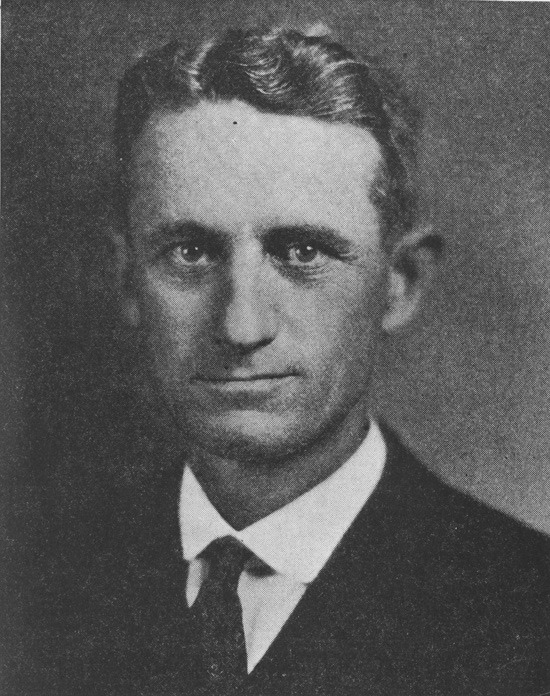
Bert Kinner never had a day of formal flight training, yet the little five-cylinder radials that carried his name taught thousands of Americans to fly. Winfield Bertrum Kinner was born in Iowa on December 16, 1882. He ran a streetcar in Denver and then worked in Minnesota as a barber, taxi operator and car dealer. On May 25, 1915, the aviator Otto Timm crashed in a field Kinner owned near Magnolia, Minnesota, and Kinner repaired the airplane's Anzani engine. Later that year he moved his family to California and opened an automobile body business. He joined the Army Air Service in 1918, but the war ended before he could train. In 1919 a sightseeing flight at Venice settled his future. He rented a barn, built an airplane and taught himself to fly it.
In 1920 he opened Kinner Field at Tweedy and Long Beach Boulevards, south of Los Angeles, with Neta Snook running the flight school. His first product was the Airster, a small 60-horsepower biplane. On January 3, 1921, a young woman named Amelia Earhart took her first lesson from Snook there, and in July 1921 she bought a yellow Airster for $2,000 and named it "The Canary." It was the first airplane she owned. On October 22, 1922, she climbed it to 14,000 feet, a women's altitude record.
Kinner moved to Glendale in 1923. His real breakthrough was a five-cylinder radial, tested quietly in a hangar in 1926 and developed with Les Bowman into the Kinner K-5. It received engine Type Certificate No. 3 on June 18, 1928, and in its developed form it gave 100 horsepower. Fleet, Fairchild, Travel Air and other builders ordered it for their trainers and sport planes. The larger B-5, certificated on May 31, 1930, gave 125 horsepower. In 1930 the carburetor maker George M. Holley recapitalized the Kinner Airplane & Motor Corporation, which went on to build the Sportster monoplane in 1932 and the Envoy cabin airplane in 1934, which the Navy also bought.
By 1933 Kinner had cut his ties to the company that bore his name. He formed Security National Aircraft Corporation at Downey and built the Security Airster S-1, a K-5-powered monoplane whose wings folded back for storage, but only a handful were sold before production stopped in 1935. The Kinner company went bankrupt in 1937. Its airplane rights went to Otto Timm, the same man whose crash had started it all, and the engine business was reorganized and kept building Kinner engines through the Second World War. Ill health led Kinner to retire around 1940, and he died in a Long Beach hospital on July 4, 1957, at 74. He is buried in the Portal of the Folded Wings Shrine to Aviation at Valhalla Memorial Park in North Hollywood. His papers are at the National Air and Space Museum.
Our 1930 Fairchild KR-21 is powered by a Kinner B-5. The KR-21 was first built with the K-5, so the airplane carries both of the engines that made his name.