Glenn Curtiss and Charles Kirkham
Two engine men from the hills above Keuka Lake, and the V-8 that carried the barnstormers
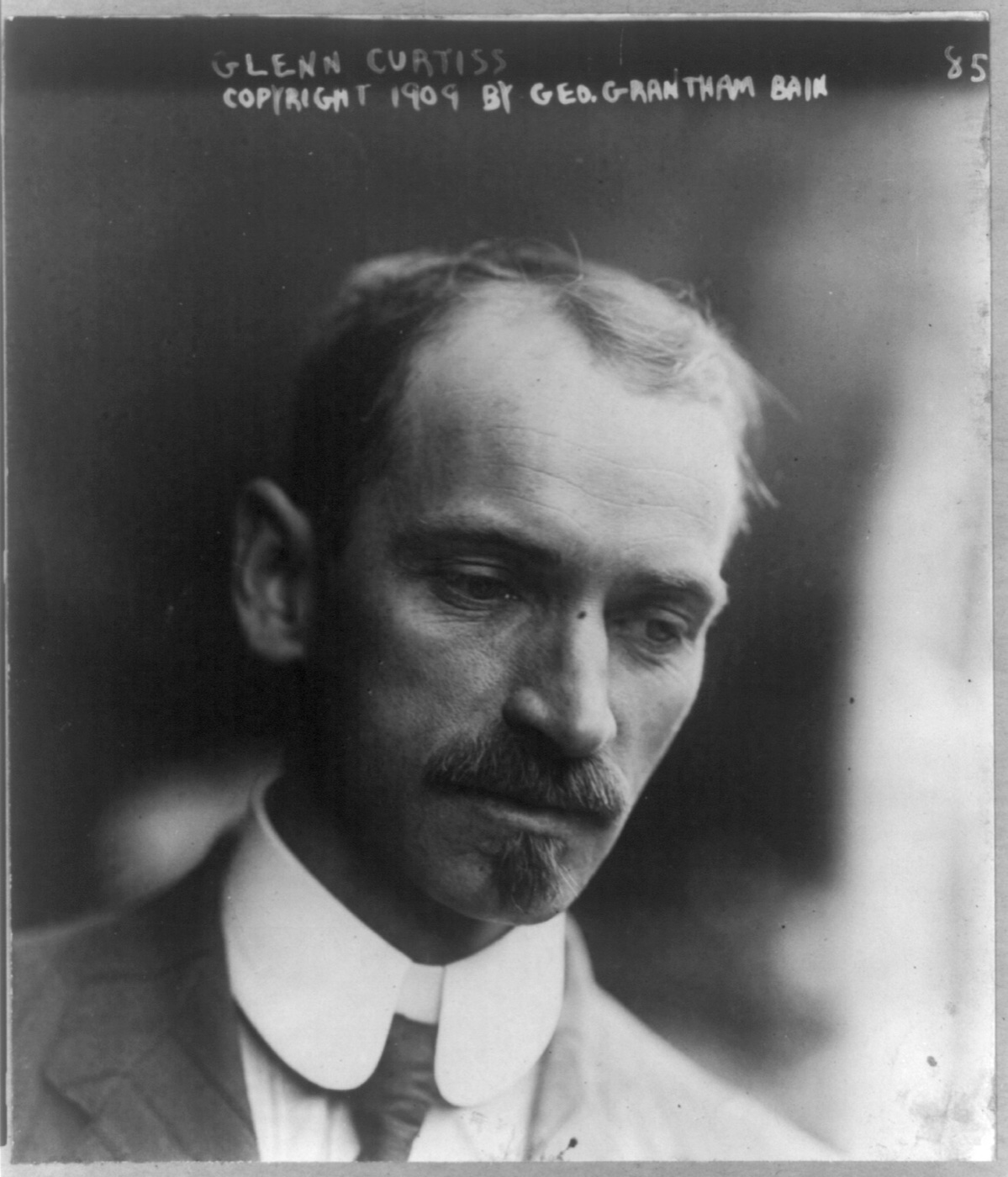
The engine that powered America's barnstorming years came out of a small corner of western New York. Glenn Hammond Curtiss (1878–1930) was born on May 21, 1878, in Hammondsport, at the head of Keuka Lake. He raced bicycles and ran a bicycle shop, and in 1902 he began building motorcycles with engines of his own design. A few miles away in Savona lived Charles B. Kirkham (1882–1969), whose family shop did casting and machining for Curtiss. Kirkham built motorcycle engines too, and in 1903 he and Curtiss supplied an engine for an early airship. Cycle World's history of Curtiss engines describes the two as partners in a long creative argument over cooling, vibration and bearings.
Curtiss engines were light, and aeronauts wanted them. In 1904 Thomas Scott Baldwin flew his airship, the California Arrow, behind a Curtiss twin. In 1906 Curtiss designed his first V-8 at the request of these experimenters, and in January 1907 he rode one, bolted into a motorcycle, at the speed carnival at Ormond Beach, Florida. He was timed at about 136 mph and was called the fastest man on Earth. On July 4, 1908, at Hammondsport, he flew the June Bug of Alexander Graham Bell's Aerial Experiment Association more than a kilometer and won the Scientific American Trophy for the first public flight of that distance in America. The Wright brothers sued him in 1909 for infringing their patent, and the fight went on until it was resolved during the First World War.
Kirkham, meanwhile, went into business for himself. He helped found the Kirkham Motor and Manufacturing Company in Bath in 1905, and between 1910 and 1912 he designed and built his own aircraft engines, among them the six-cylinder B-6. In 1915 he joined Curtiss as chief engineer for engines. Curtiss's OX series dated from about 1912, and its best-known member, the 90-horsepower OX-5, was refined in 1915 by a team that included Kirkham, shop chief Henry Kleckler and Charles Manly. Kirkham's own Curtiss designs were bigger. His aluminum-block K-12 V-12 first ran in 1916, and the Curtiss 18 triplane built around it, often called the Kirkham Triplane, flew in 1918 and was timed at 163 mph. The K-12 was the basis for the Curtiss D-12 of 1922.
The Curtiss Aeroplane and Motor Company was formed in 1916 and moved its headquarters to Buffalo, and during the war it was the country's largest aircraft builder. More than 10,000 OX-5s were built, most for the JN-4 Jenny trainer. After the war the government sold off thousands of surplus OX-5s and Jennys for a fraction of their cost. They put a generation of barnstormers and private pilots in the air, and makers such as Travel Air, Waco and Alexander built commercial biplanes around the engine. As late as 1929, more than a third of the licensed airplanes in America used an OX-5.
Kirkham left Curtiss in 1919 to start his own firm, Kirkham Products. On Long Island his shop built a flying yacht for Harold S. Vanderbilt and, in 1927, a racer meant for the Schneider Trophy, which Navy Lt. Al Williams flew unofficially at 322 mph. In 1929 he designed and built an experimental vertically opposed, air-cooled six. He died in 1969. Curtiss sold a large part of his stock in 1920 and moved to Florida, where he and the rancher James Bright developed Hialeah, Miami Springs and Opa-locka. Traveling to Rochester to fight a lawsuit brought by his former partner Augustus Herring, he suffered an attack of appendicitis. He died in Buffalo of complications after surgery on July 23, 1930, at 52, and is buried in Pleasant Valley Cemetery in Hammondsport.
Our 1928 Alexander Long Wing Eaglerock flies behind a Curtiss OX-5, the only OX-5 in our hangars. It is the engine of the barnstorming years, the type the two men refined in 1915.