Russell Nicholas and Howard Beazley
The garage men who made Marshall, Missouri, an airplane town
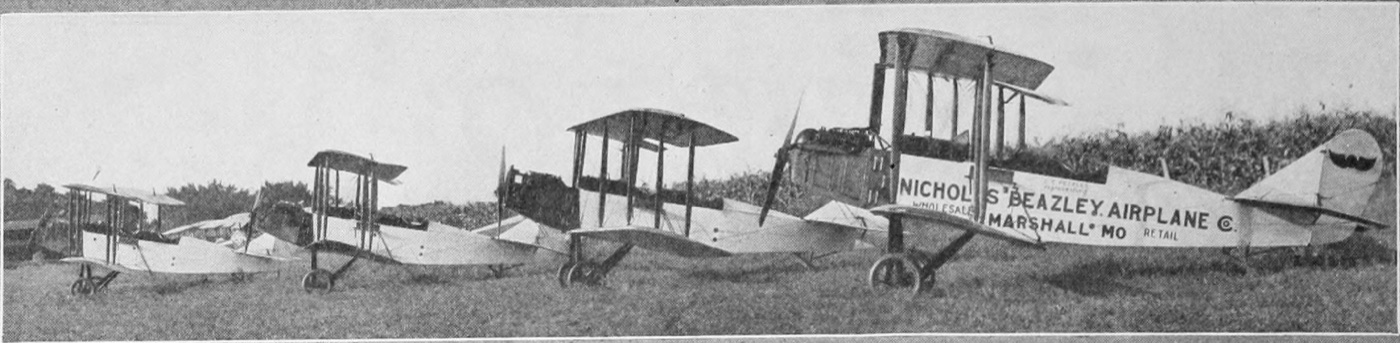
In the 1920s a small town in central Missouri shipped airplane parts from coast to coast, ran one of the busiest flying schools in America and built its own airplanes, and the two men behind all of it got their start in the automobile business. Russell B. "Penny" Nicholas and Howard Beazley were boyhood friends who turned a trade in war-surplus parts into one of the best-known aviation supply houses of its day.
Nicholas started the Central Aviation Company in Marshall in 1921, reselling surplus propellers, and the business grew into a mail-order house for surplus Curtiss OX-5 engine parts. Beazley became his partner in 1924 and the firm became the Nicholas-Beazley Airplane Company. It rebuilt war-surplus Standard J trainers, and in September 1926 Aero Digest reported a new Standard J-1 commercial model "in full production" at Marshall, built from war-production material with a shortened fuselage. Its catalog offered everything from dope and fabric to instruments, and by 1929 its chain of supply depots reached Curtiss Field on Long Island. Beazley's Marshall Flying School opened on March 6, 1924, and by January 1928 it was billing itself as the largest civilian flying school in the world. One early customer was Justin McInaney, sent from Denver by J. Don Alexander to learn to fly and buy an airplane. McInaney took lessons from Ben O. Howard and flew home in a $2,300 Swallow, the airplane that started Alexander in the aircraft business.
In 1927 the partners hired Walter H. Barling to design an airplane of their own. Born in Kent, England, in 1890, Barling had worked at the Royal Aircraft Factory before coming to the United States in 1919 to design the Army's Barling Bomber, the largest airplane in the world when it flew in 1923. His Barling NB-3, a two-seat low-wing monoplane, first flew in February 1928. Test pilot Dwight "Barney" Zimmerley set light-plane altitude and distance records in one in 1929. Barling later settled in Santa Cruz, California, where he died in 1965.
The airplane most people remember came from Tom Kirkup, who joined the company in 1929. His NB-8 was a two-seat parasol trainer with side-by-side seats, a choice of small engines, among them the 80-horsepower Armstrong Siddeley Genet that put the G in NB-8G, and wings that folded back so the airplane could be towed behind a car and kept in a garage. Production began in October 1931. Fifty-seven were built in 1931 and 1932, and a fifty-eighth was assembled from spare parts in 1935. The Depression arrived along with it. In 1932 the company dropped its dealers, sold direct from the factory and cut the price by $500. Airplane production ended in 1937, and in May 1938 the airplane business was sold to Air Associates, an eastern supply house.
Marshall has not forgotten them. The Nicholas-Beazley Aviation Museum at Marshall Memorial Municipal Airport displays an NB-3 and an NB-8G. Our 1932 Nicholas-Beazley NB-8G, arriving at The Caldwell Collection at Mustang Field this fall, comes from Kirkup's folding-wing line, the trainer that kept the Marshall factory building airplanes into the Depression.