Major Reuben H. Fleet
1887–1975
The Army major who started the air mail and built Consolidated Aircraft
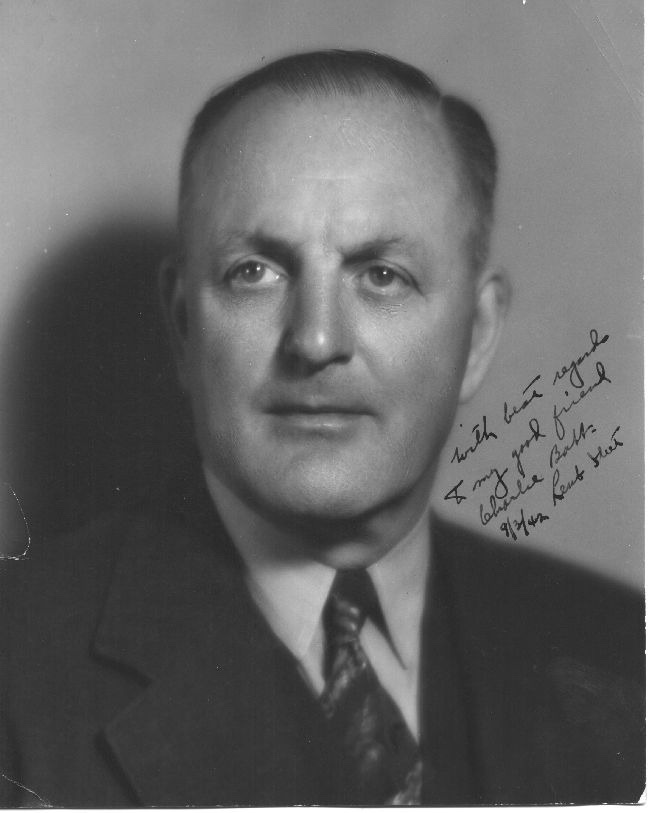
Reuben Hollis Fleet launched the first scheduled air mail in the United States, built the company that gave the world the Catalina and the Liberator, and lent his name to a little biplane trainer. He was born near Montesano, Washington Territory, on March 6, 1887, and graduated in 1906 from Culver Military Academy in Indiana, where his uncle was superintendent. Back home he taught school and then, while still in his twenties, prospered in real estate and timberland. He also served as an officer in the Washington National Guard, and in 1915 he went to the state legislature as its youngest member, and there he proposed $250,000 to train Guardsmen as pilots.
In 1917 he learned to fly at North Island in San Diego, qualified as Military Aviator No. 74, and was commissioned a major in the Signal Corps. In May 1918 the Army gave him a few weeks to set up an air mail route between Washington, Philadelphia and New York. Fleet himself flew one of the Curtiss Jennies south through fog, landing in Washington early on May 15, the opening morning. At Potomac Park, with President Wilson watching, Lt. George Boyle's Jenny would not start until someone found its fuel tank empty. Boyle then flew the wrong way and landed at Waldorf, Maryland, and his mail went back to Washington by truck. The other legs of the route were flown successfully that day, and the service went on. In January 1919 he went to McCook Field in Dayton, Ohio, where he became the Air Service's chief contracting officer, and he resigned in November 1922.
He became general manager of the Gallaudet Aircraft Corporation, and on May 29, 1923, he organized the Consolidated Aircraft Corporation in Gallaudet's factory at East Greenwich, Rhode Island. He had bought the Dayton-Wright company's trainer designs, including the TW-3, and a refined version won an Army order for 50 airplanes in 1924 as the PT-1, which cadets nicknamed "Trusty" for the way it came out of spins. That September Consolidated moved to the former Curtiss plant in Buffalo. Its 1929 Commodore flying boat led to the PBY Catalina. In 1935 Fleet moved the whole company to San Diego in 157 railroad cars, and the new plant opened on October 20. There it built the Catalina and the B-24 Liberator.
In November 1941 Fleet sold his controlling stake to Victor Emanuel's Aviation Corporation for $10.9 million. The company merged with Aviation's Vultee subsidiary in 1943 to form Consolidated Vultee, later called Convair. Fleet stayed in San Diego, where he helped found the city's aerospace museum, was named "Mr. San Diego," and gave the city the Reuben H. Fleet Space Theater. He died in San Diego on October 29, 1975, at 88, after a fall, and is buried at Fort Rosecrans National Cemetery on Point Loma. His papers are at the San Diego Air & Space Museum.
When Consolidated dropped plans to sell its Model 14 Husky Junior trainer to private flyers, Fleet bought the rights, and in 1929 he formed Fleet Aircraft to build it. Consolidated soon brought that company back as a division, and Fleet Aircraft of Canada followed at Fort Erie, Ontario, in 1930. Our 1929 Fleet Model 1 in The Caldwell Collection at Mustang Field comes from that line, the two-seat trainer that carried his name.