T. Claude Ryan
1898–1982
The airline pioneer whose trainers taught a nation to fly
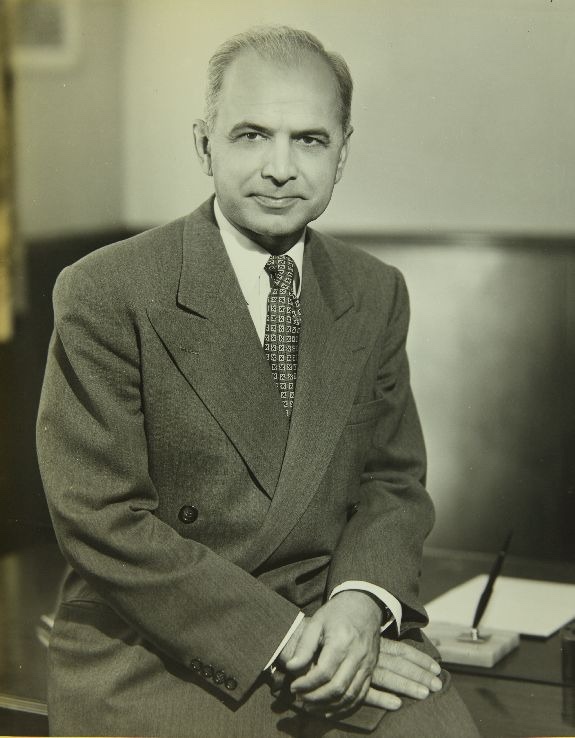
T. Claude Ryan started with one secondhand airplane on the San Diego waterfront and finished at the head of a company that built jet fighters, drones and vertical-takeoff aircraft. Tubal Claude Ryan was born in Parsons, Kansas, on January 3, 1898. Calbraith Rodgers's 1911 transcontinental flight passed near his boyhood home and gave him his first inspiration, and in 1912 his family moved to Orange, California. In 1917 he made his first solo at the American School of Aviation in Venice. After a year of engineering at Oregon State College he entered the Army Air Service, earned his wings at March Field, and flew forest-fire patrols over northern California and Oregon until 1922.
That year he bought a war-surplus Curtiss JN-4 Jenny and began selling rides and lessons from Dutch Flats in San Diego. With B. F. Mahoney as his partner he opened the Los Angeles–San Diego Air Line on March 1, 1925. It is widely described as the first regularly scheduled, year-round passenger airline in the United States. In 1926 Ryan Airlines brought out the M-1 mail monoplane, its first production airplane. On November 23, 1926, Ryan sold his interest to Mahoney, staying on briefly as manager before leaving in the spring of 1927. The Spirit of St. Louis, which the company built that spring from the M-1 pattern to a design by chief engineer Donald Hall, came out of a factory that still carried Ryan's name but no longer belonged to him.
He opened the Ryan Flying School in 1928 and organized the Ryan School of Aeronautics in 1931. In 1934 he founded the Ryan Aeronautical Company, and on June 8 of that year the first Ryan ST, designed with engineers Millard Boyd and Will Vandermeer, made its first flight. The ST and STA sport trainers led to the Army's PT-16, PT-20, PT-21 and PT-22 Recruit, and during the war Ryan's schools trained thousands of Army pilots. The company went on to build the FR-1 Fireball, a Navy fighter with a piston engine in front and a jet in back, then the postwar Navion, the Firebee target drones and the X-13 Vertijet.
Teledyne bought the company for $128 million, and in 1969 it became Teledyne Ryan Aeronautical. Ryan stepped back from running it and, with his son Jerome, formed the Ryson Corporation to build the ST-100 Cloudster motor glider. He died in San Diego on September 11, 1982, at 84. He was enshrined in the National Aviation Hall of Fame in 1974, and his photograph albums are in the archives of the San Diego Air & Space Museum.
Our 1938 Ryan SCW-145 in The Caldwell Collection at Mustang Field comes from the company he founded and led. The SCW is a three-place cabin monoplane, designed as a more comfortable sister of the ST, and only about a dozen were built. Ours flew with the Civil Air Patrol's coastal patrol during the Second World War and came home to the United States in 2026 after years in Australia.