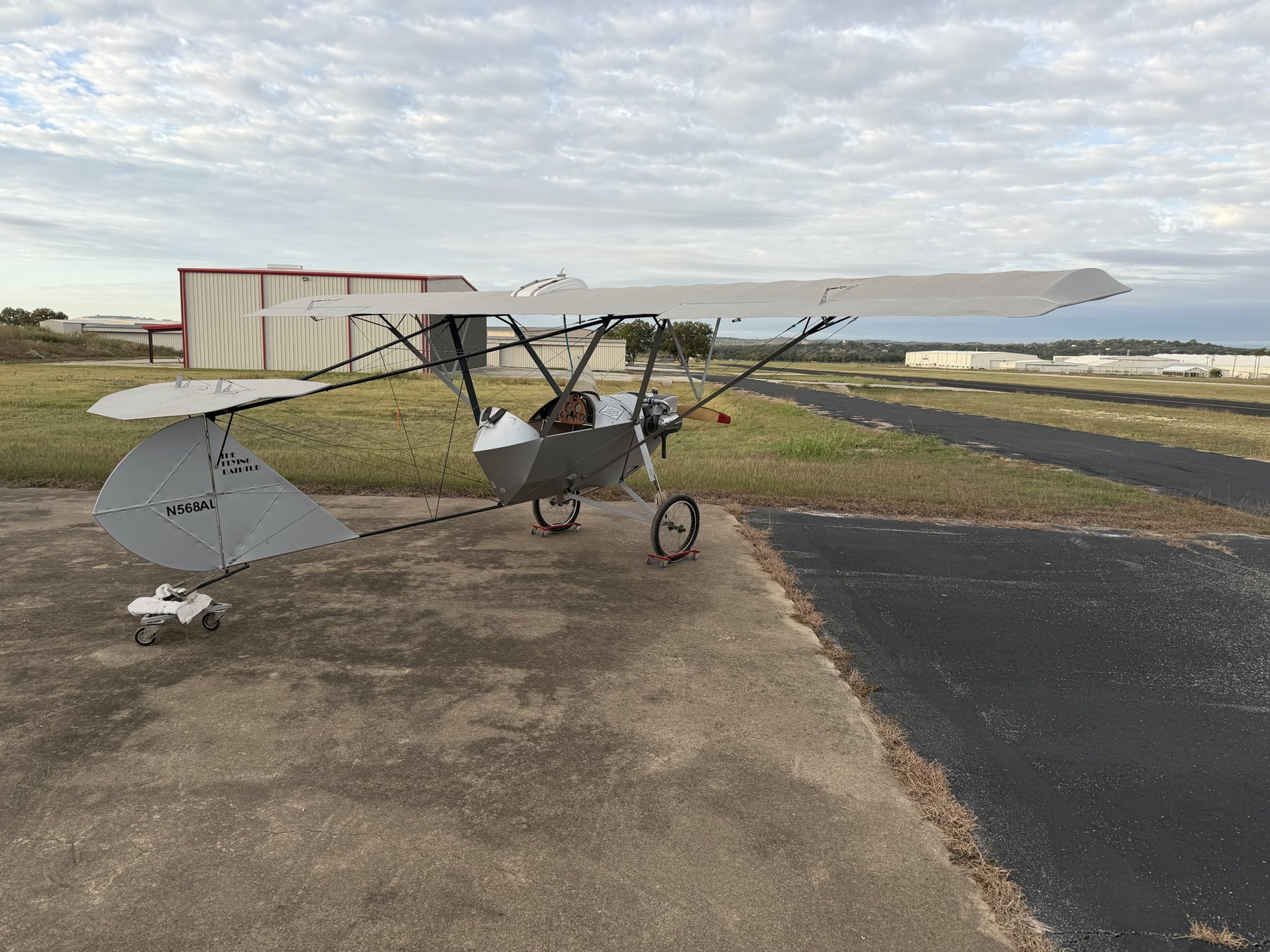
1923 Dormoy Bathtub Reproduction
A reproduction of the airplane Étienne Dormoy designed in a Dayton hangar in 1923, built eighty-nine years later by an aeronautical engineer, Air Force veteran and solo trans-Atlantic sailor named Nick Leonard, and donated to the Collection by his son.
A reproduction of Étienne Dormoy’s 1924 race winner, built by engineer and solo trans-Atlantic sailor Nick Leonard and donated by his son.
A reproduction of Étienne Dormoy’s 1924 race winner, built by engineer and solo trans-Atlantic sailor Nick Leonard and donated by his son.
The Flying Bathtub, and Why That Name
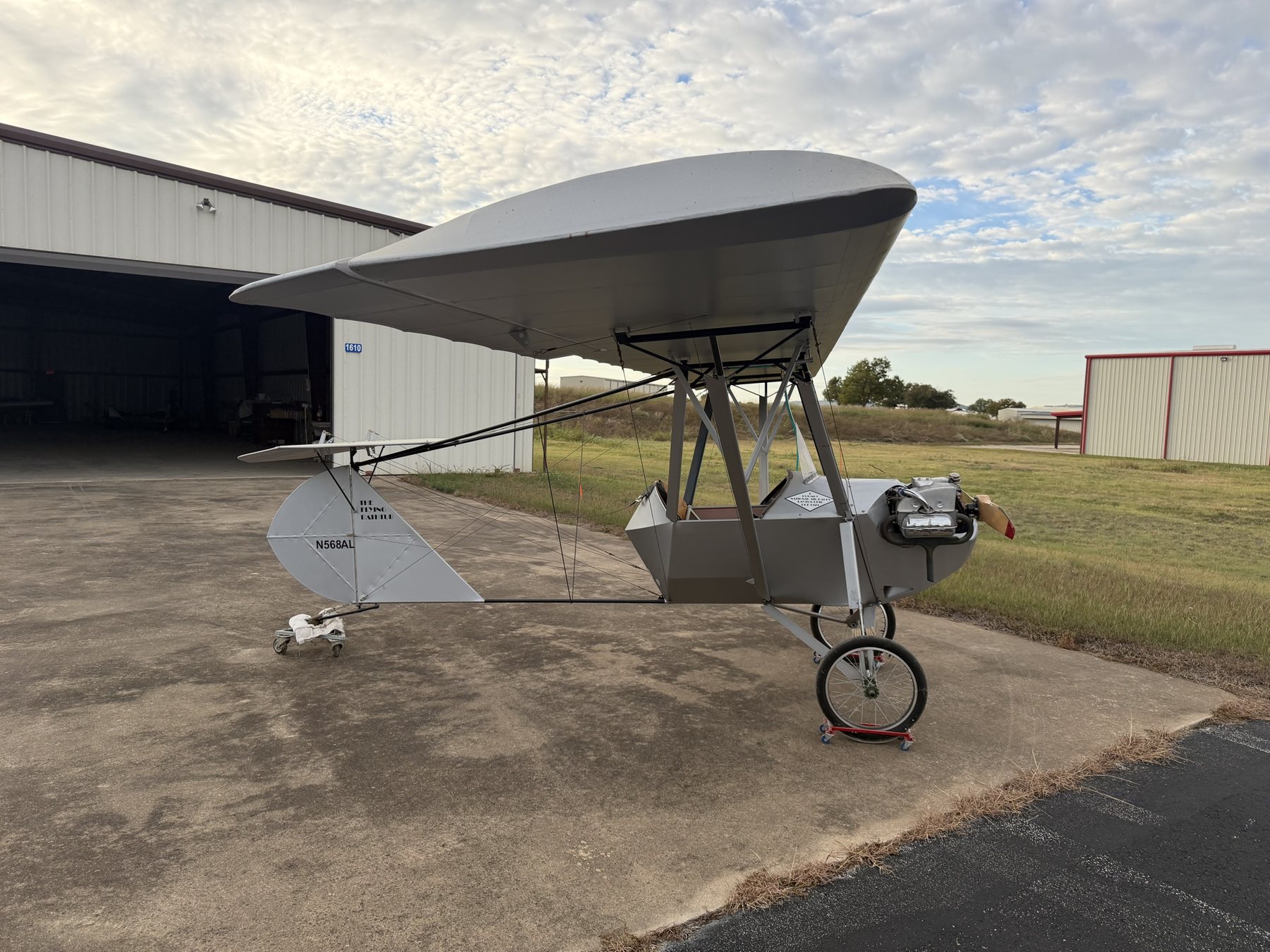
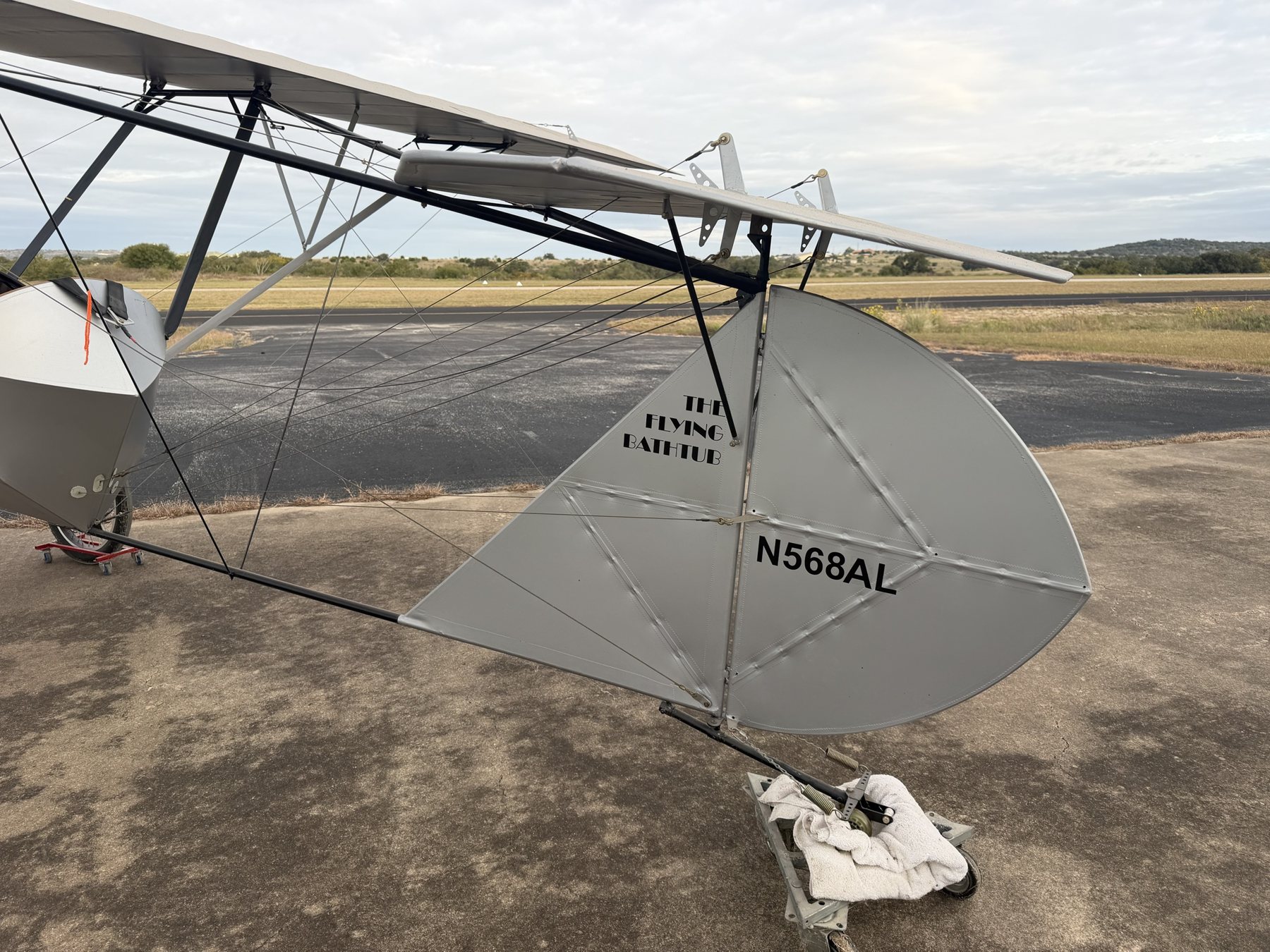
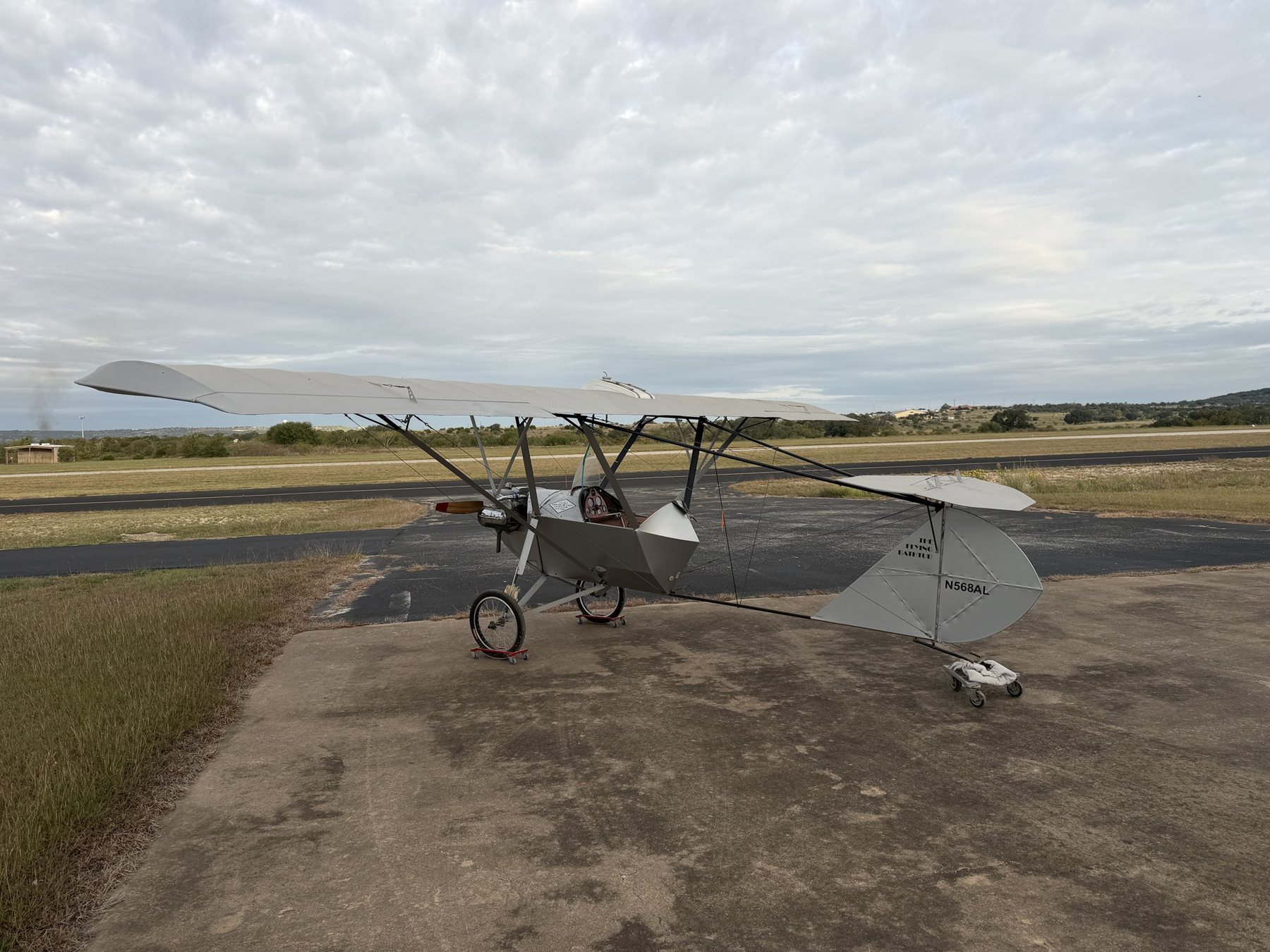
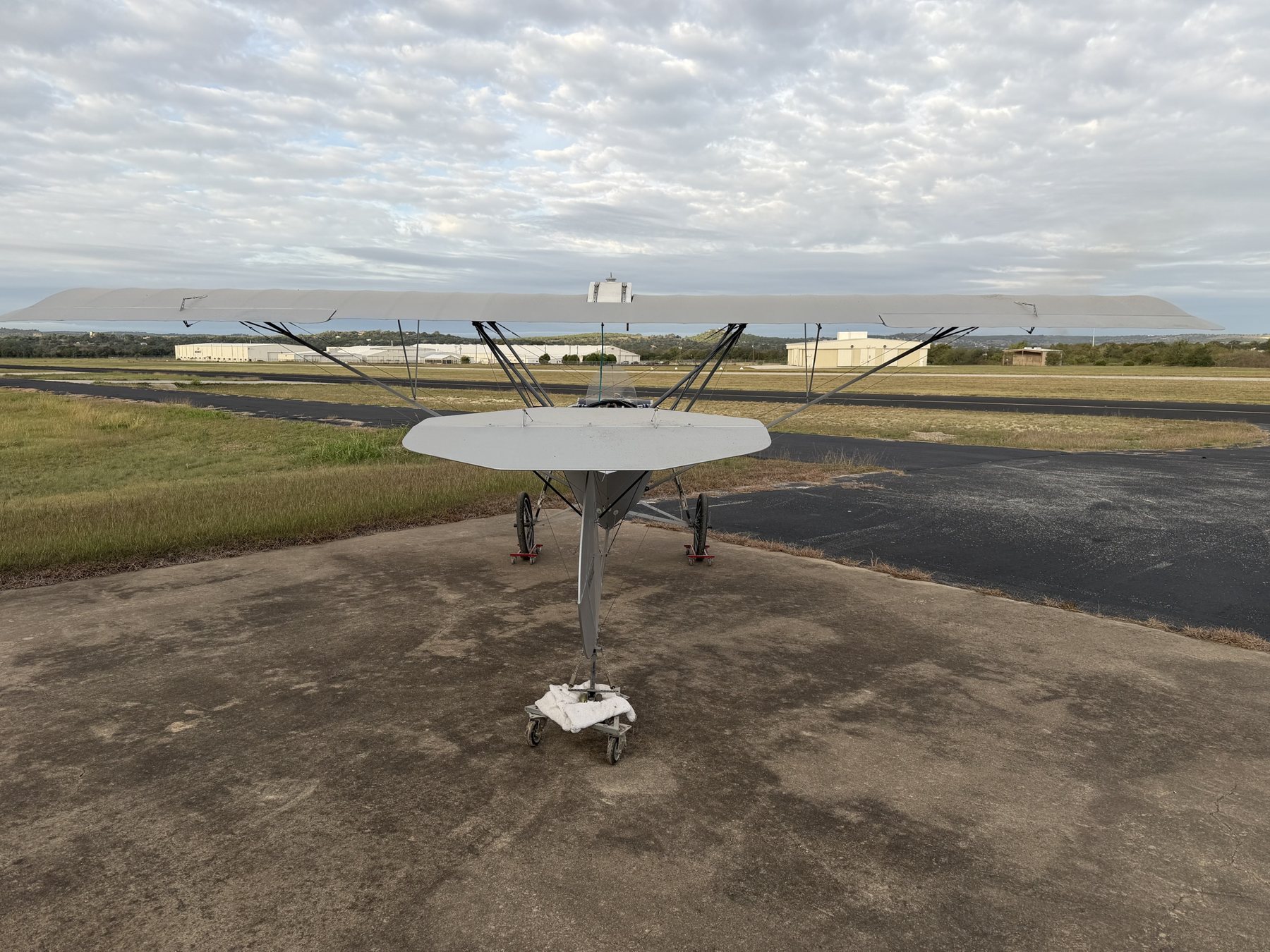
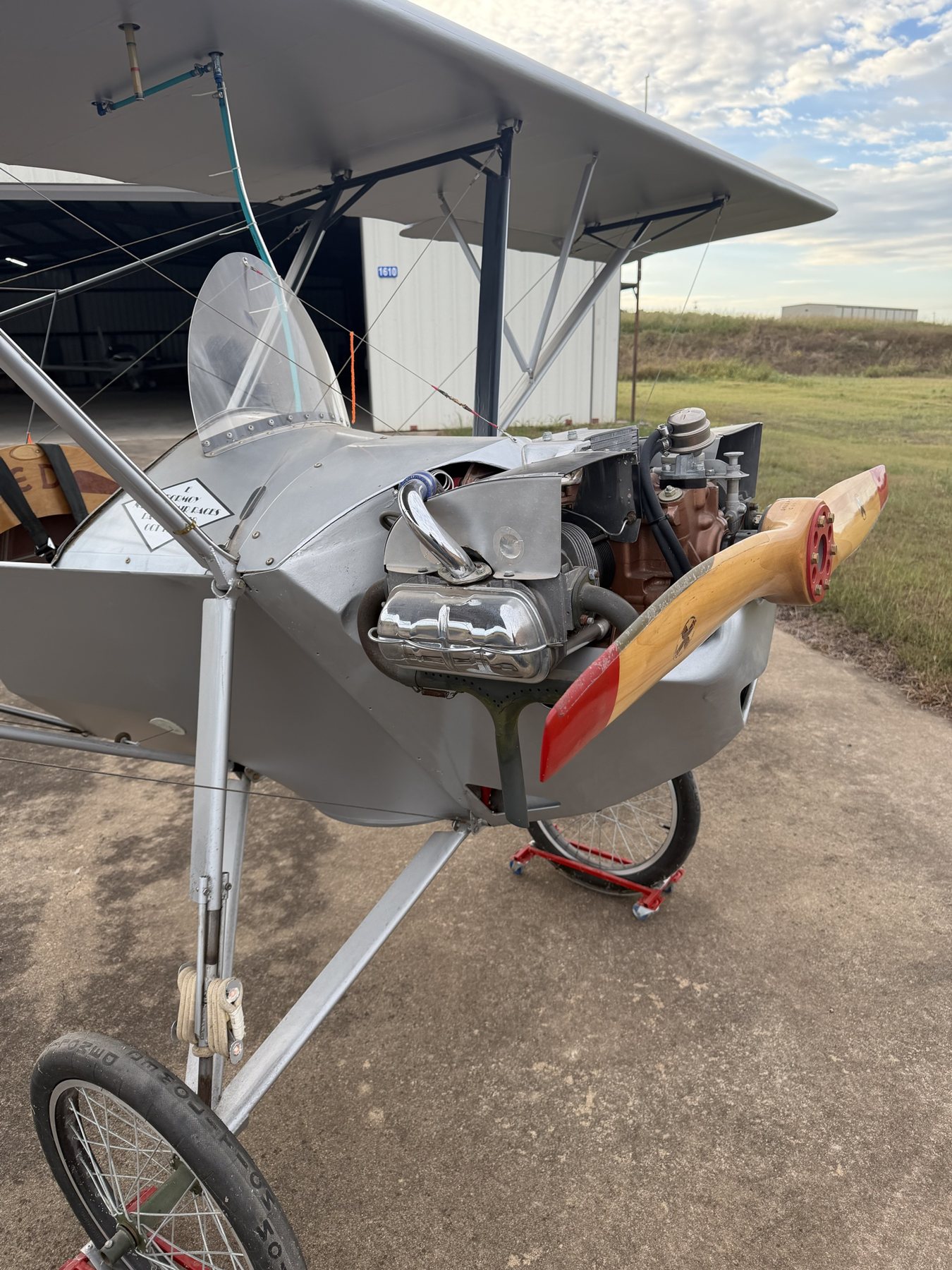
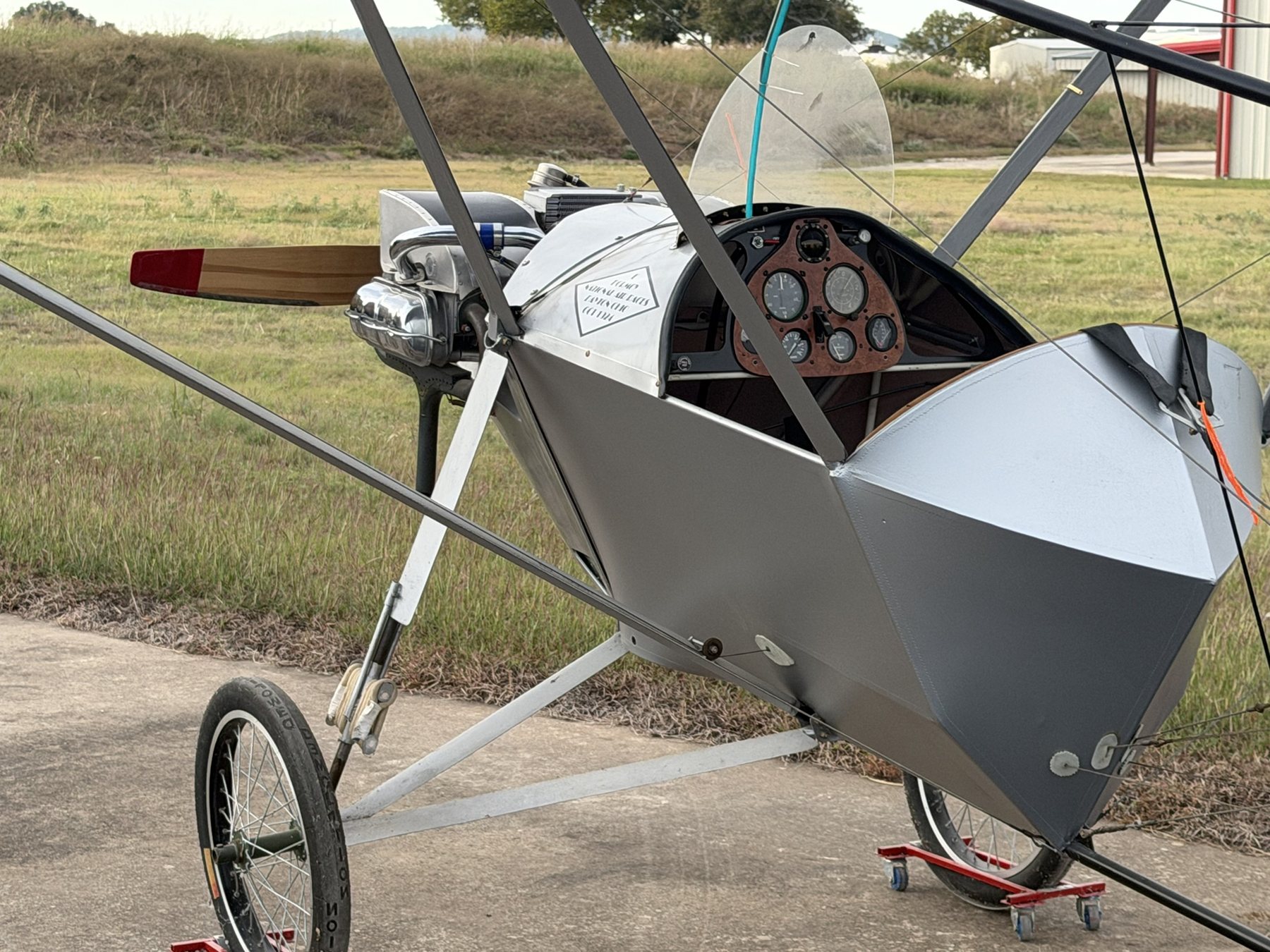
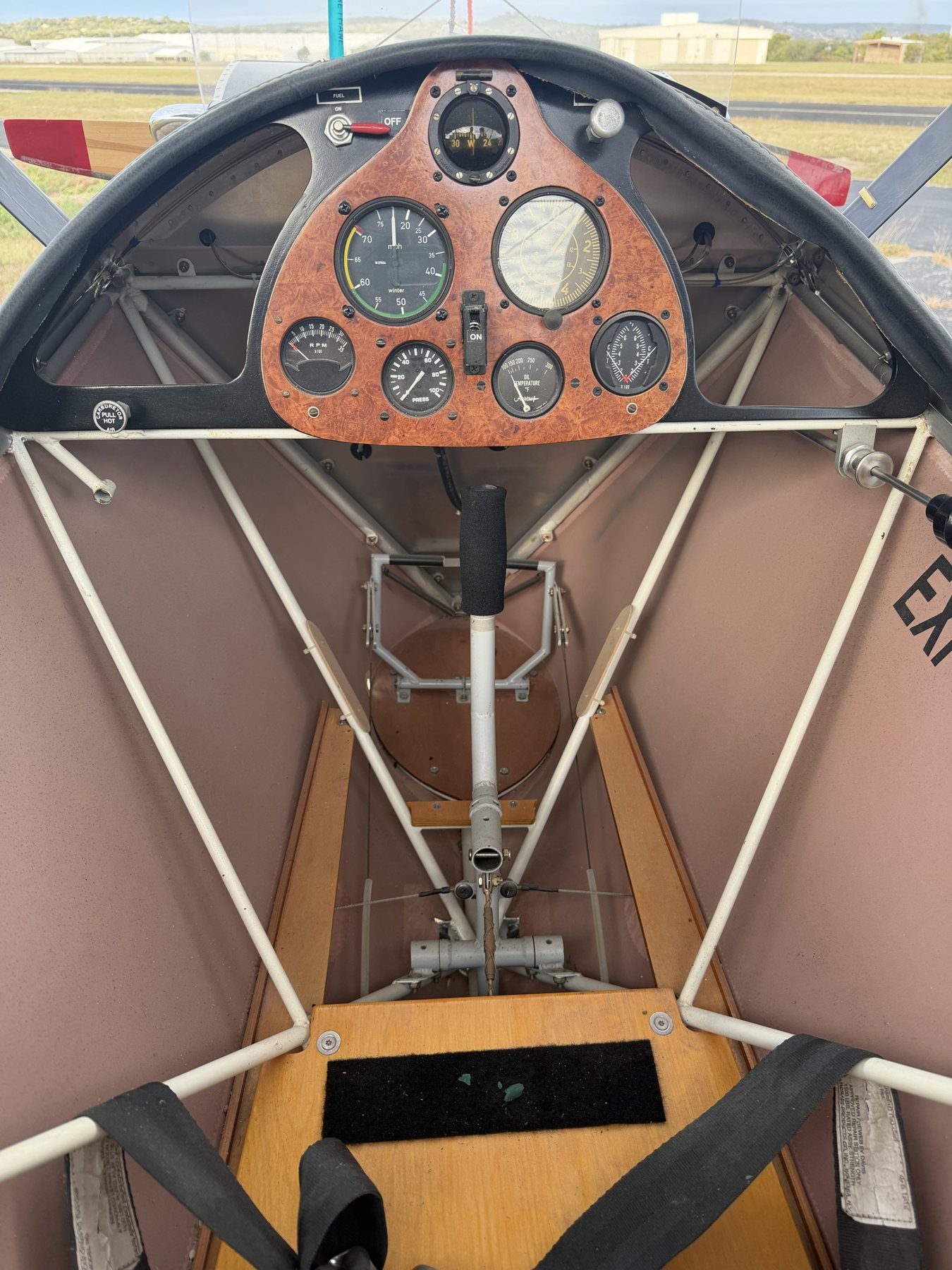
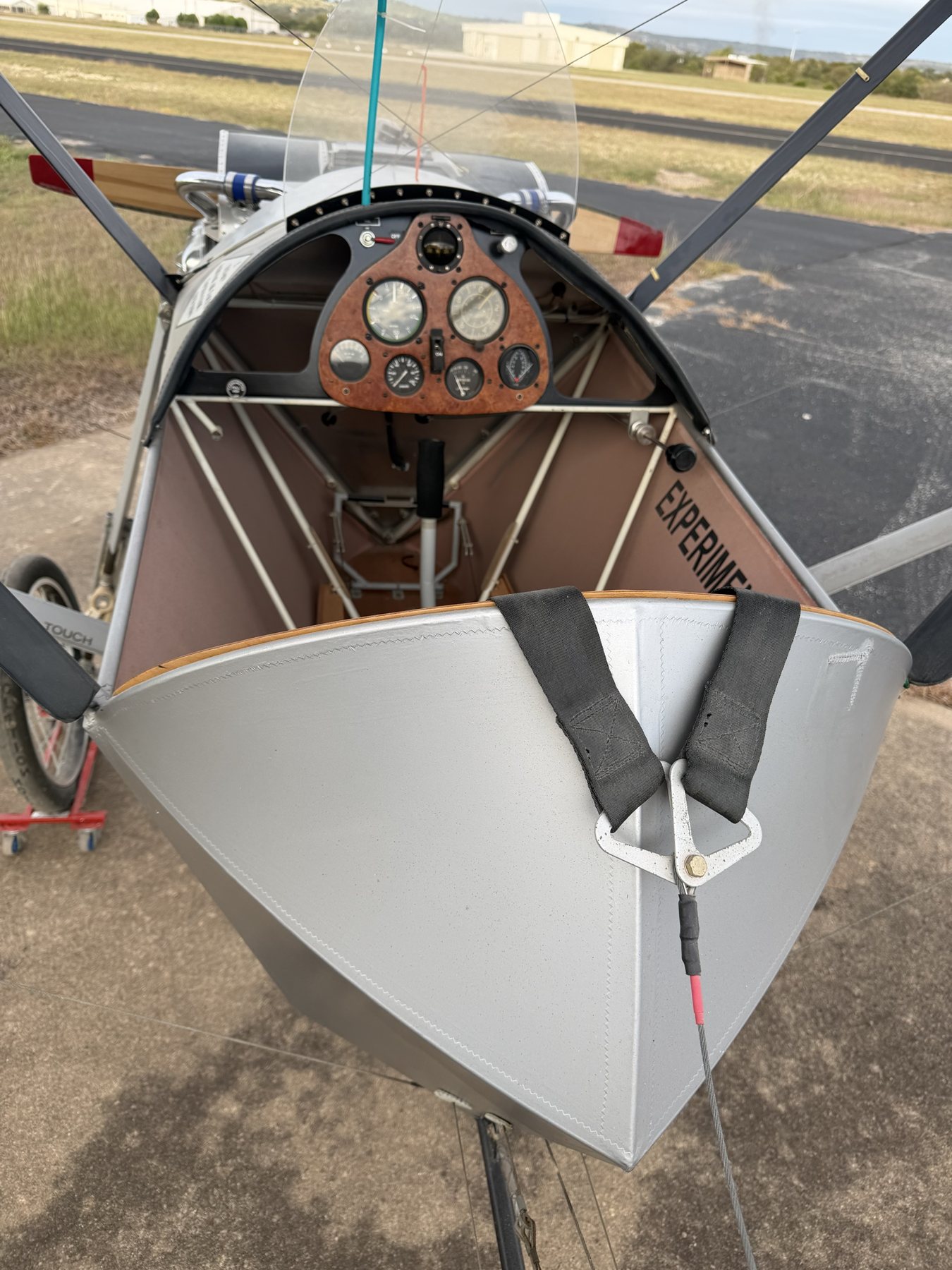
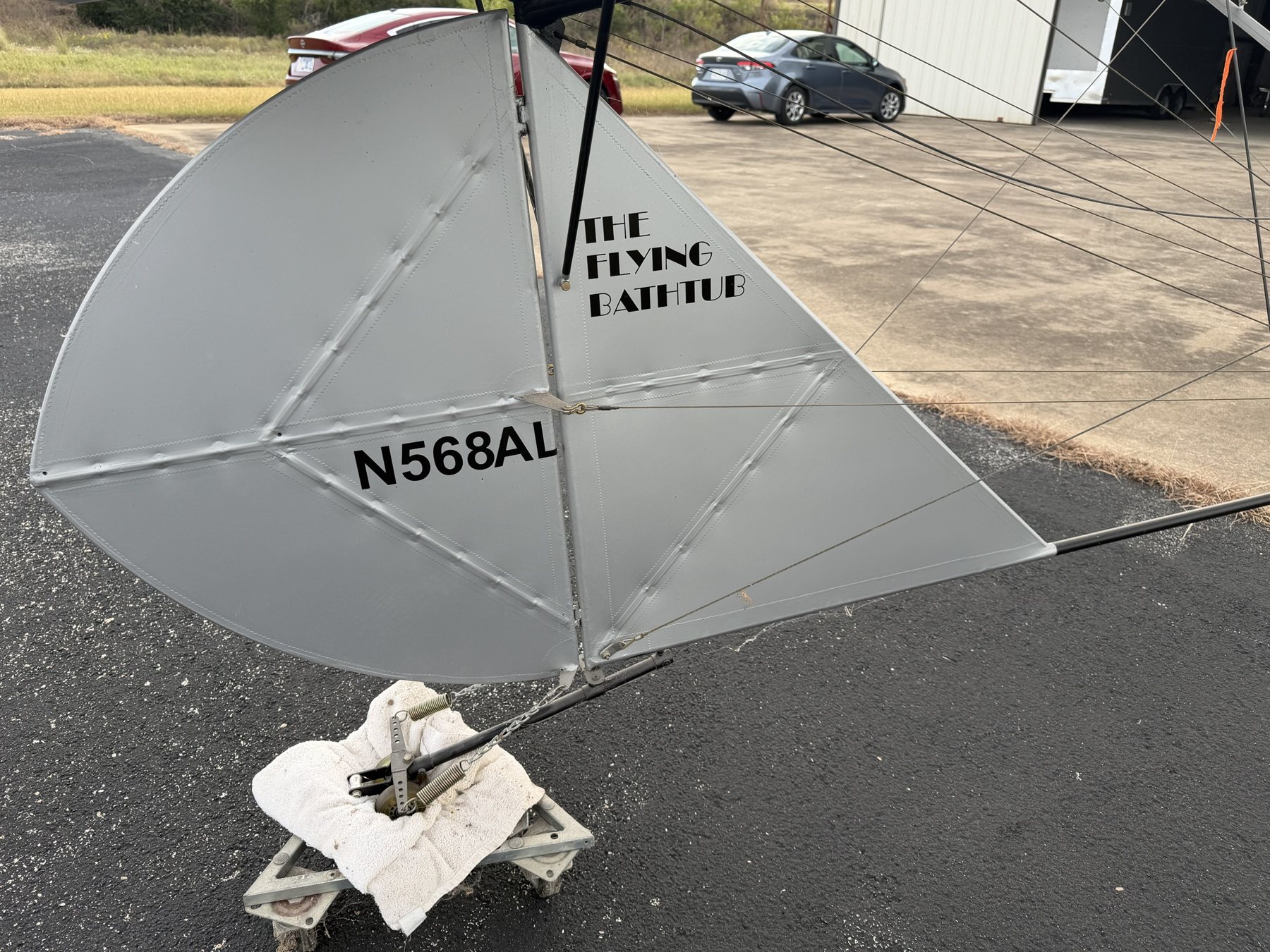
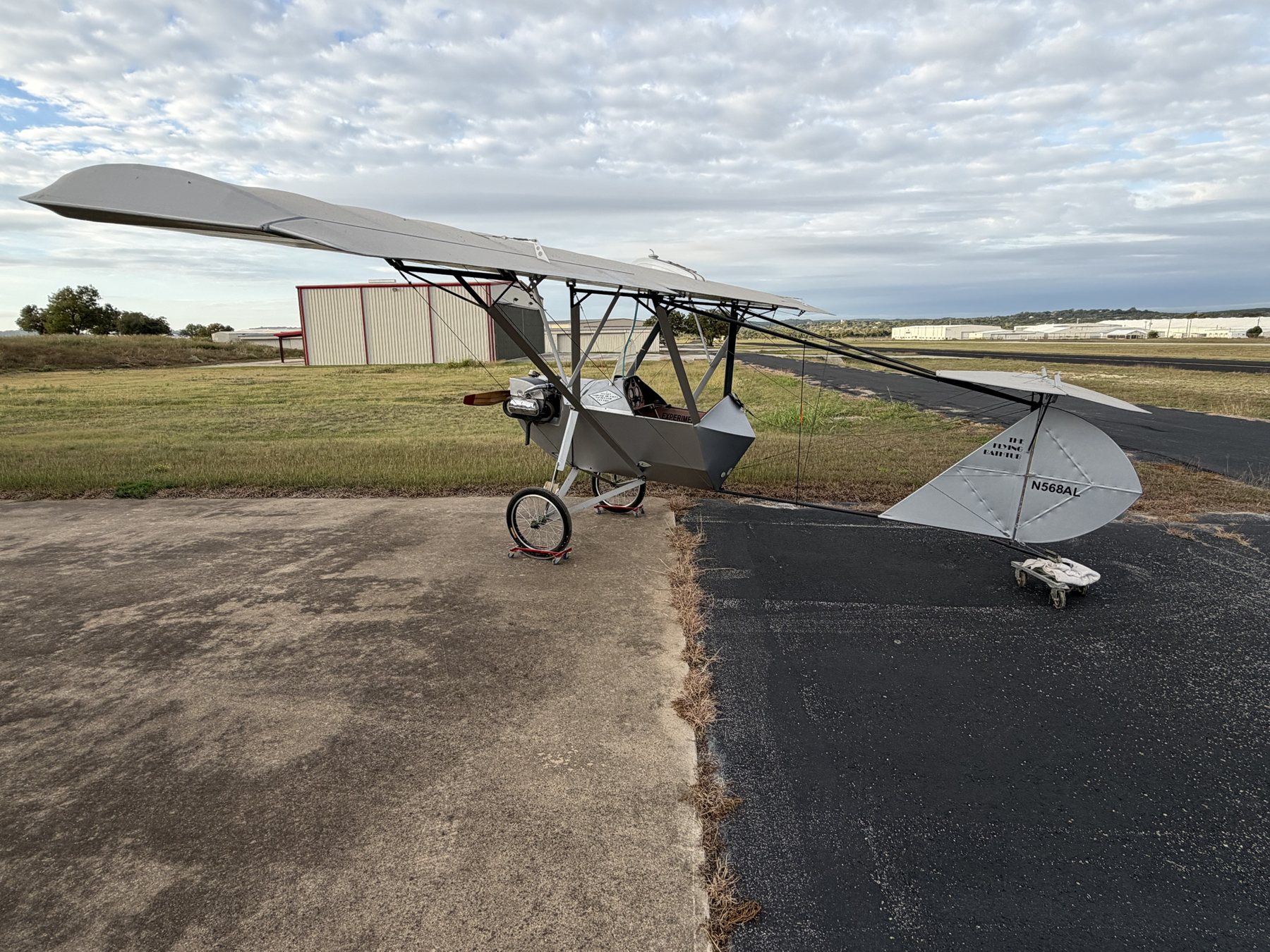
Walk around a Dormoy Bathtub for the first time and the thing you are looking for is a tail. On almost any airplane you can trace the fuselage from the nose to the tail post in one continuous line, because the airplane needs a skin everywhere a man might reach his hand through it. On the Bathtub the skin stops behind the pilot. The structure keeps going, four slender steel tubes converging toward a vertical fin and a horizontal stabilizer at the far end, and the pilot sits in a short open box at the front with the engine out in front of him and the wing on four steel struts above his head. That short open box is the bathtub. If you have ever seen one you cannot unsee the name.
Everything else about the airplane is of a piece with the fuselage. Twenty-four feet of wingspan, thirteen and a half feet of length, four hundred and twenty-five pounds of gross weight, eighty-five square feet of wing, and a two-gallon fuel tank — not a two-gallon reserve, two gallons total. The parasol wing uses wooden spars with fabric covering, and the aileron cables run exposed ahead of the leading edge where you can watch them move. Dormoy's own account, preserved in family papers, was that everything on the airplane except the engine came from a hardware store. That is a line a designer says for effect, but it is a line only an engineer with his training is entitled to say.
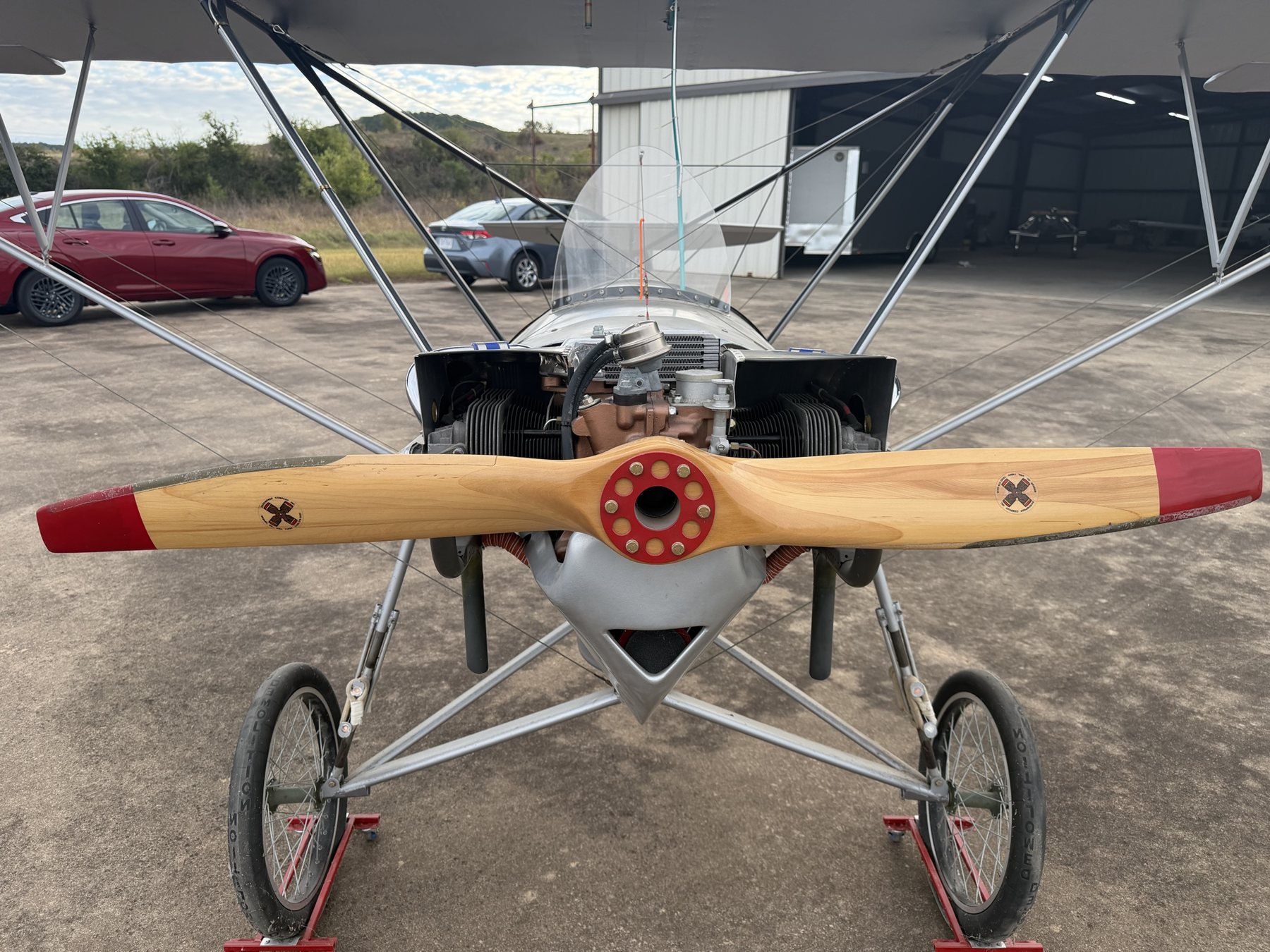
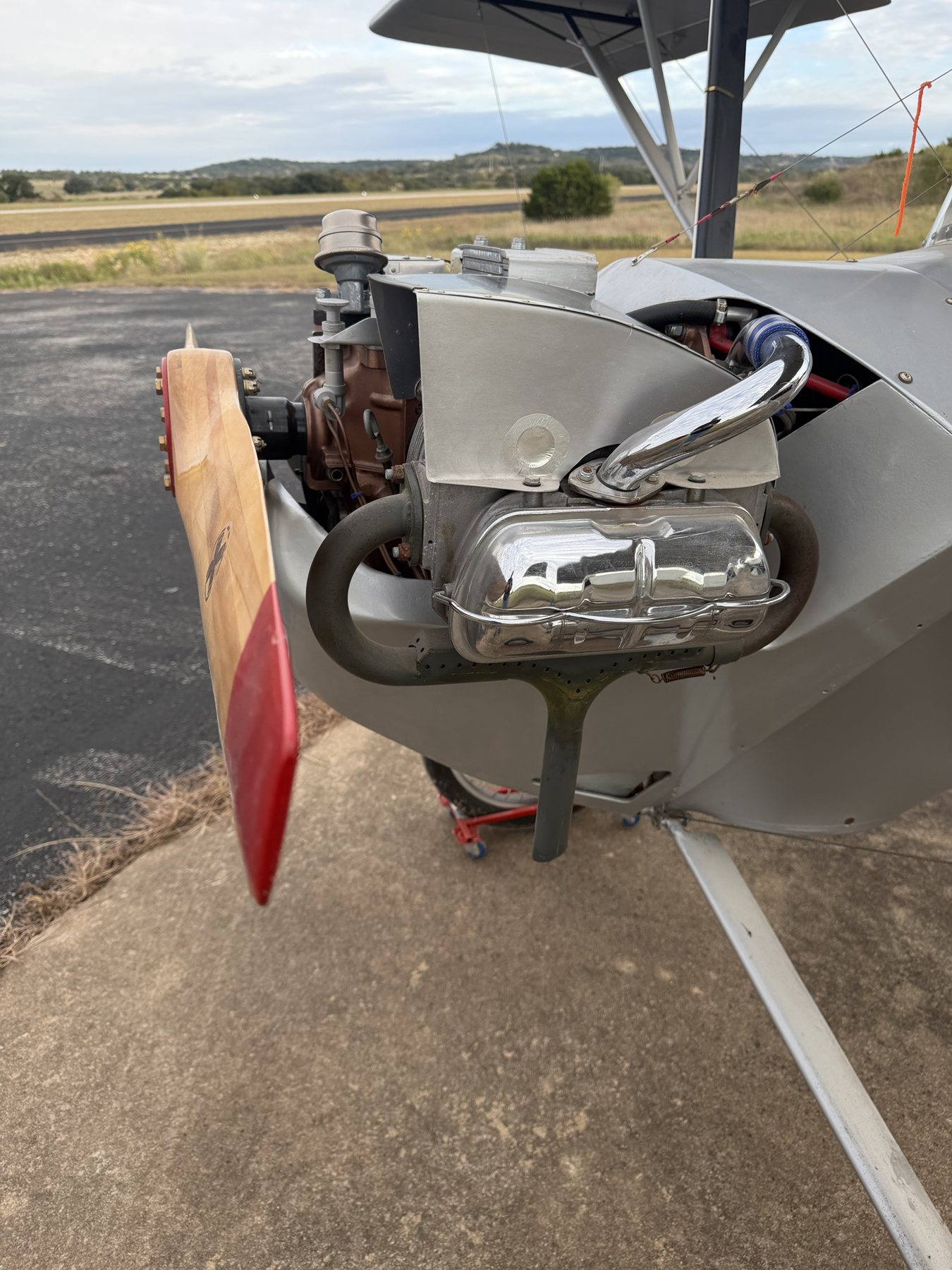
The original 1924 power was a Henderson four-cylinder motorcycle engine, bought by Dormoy for three hundred and twenty-five dollars, developing something around twenty horsepower. The single most consequential piece of engineering on the airplane was invisible — a cooling duct Dormoy worked out for the Henderson that let it run cross-country without seizing up, when every other motorcycle-engined entry at the 1924 races had to force-land along the way. Our airplane carries the same airframe geometry he drew, built in 4130 steel tube and covered in fabric to Mike Kimbrel's redrawn plans of the 1970s, and a Volkswagen conversion stands in for the Henderson, which has not been obtainable in flyable condition for seventy years. The Volkswagen was Kimbrel's substitution and it is the engine every surviving Bathtub reproduction in the United States has flown behind since 1978. Our airplane has one at approximately forty horsepower, driving a 54-inch Arrowprop laminated birch propeller made in Meeker, Oklahoma, an hour from where the airplane now lives.
Étienne Dormoy — French Engineer, American Original
The man who designed this airplane had one of the most remarkable aviation careers of the first half of the twentieth century, and almost no one outside the specialist literature has ever heard his name. He was born in 1885 at Vandoncourt in eastern France, took a civil engineering diploma at Lille in 1906, and went to work in 1911 for Deperdussin, the Paris firm that built the world's first monocoque fuselages. The monocoque technique — narrow strips of thin wood wrapped and glued around a form until the body of the airplane needs no internal bracing — was the most advanced structural idea in aviation, and Dormoy became expert at it. In 1913 he was sent to Paterson, New Jersey, to build the first true monocoque fuselage constructed in the United States. The pilot who won the New York Times race of 1914 flew on his fuselage.
When the war came he went home, joined the French air service, qualified as a pilot in 1915, and became one of the first men to fly night sorties against zeppelins, coming back on two occasions with his Voisin punched by gunfire. He flew his last combat mission in January 1916 and was posted back to Deperdussin to help design the SPAD — the fighter. In 1917 he was sent to America with two SPADs and a set of blueprints under his arm to teach the Curtiss plant at Buffalo how to build them, under a Signal Corps contract. The Hispano-Suiza engines never arrived, the war ended, and the project collapsed. He joined Packard in 1919 and was fired from it in 1920 for drawing airplanes instead of automobiles, which is the most characteristic sentence in his biography and ought to be carved somewhere.
He then went to the Engineering Division of the Army Air Service at McCook Field in Dayton as a civilian engineer and stayed until 1925. There, in August 1921, he fitted a Curtiss JN-4 Jenny with a hopper he had designed to spray chemicals from an airplane, flown by Lieutenant John A. Macready in a demonstration against a stand of catalpa trees at Troy, Ohio. That was the first crop duster. Dormoy designed the hopper, which means we have — through this airplane — a direct designer connection to the beginnings of agricultural aviation. He also designed, in the hours he was not supposed to be designing light airplanes on government time, the Bathtub.
In 1925 he left government service for the Buhl Aircraft Company of Detroit, where he was chief engineer until the Depression closed the firm in 1932. He designed all of the Buhl airplanes. The Buhl-Verville Airster carries Approved Type Certificate Number 1, issued in March 1927 — the first type-certificated airplane in the United States, and thus the ancestor of every certificated airplane since. He designed the Buhl Airsedan, of which more than sixty were built and one of which, the Spokane Sun God, made the first nonstop round-trip flight across the United States in August 1929. He designed the Bull Pup of 1930. He prototyped the first autogyro in the world with a pusher engine. Then he went to Boeing in Seattle, worked in the wind-tunnel division, and contributed to the P-26 Peashooter. He became an American citizen in 1933. The damp Seattle climate gave him allergies and in 1936 he moved to Consolidated in San Diego, which later became Convair, and he worked with Isaac Laddon on the PBY Catalina. He retired in 1958 as senior design engineer, then designed a collapsible boat and a barbecue grill, because he could not stop. He died in San Diego in February 1959.
That is the man whose airplane we are flying.
October 1924 — The Rickenbacker Trophy
The 1924 International Air Races ran at the fields outside Dayton from October second to the fourth. One hundred and seventy-four entries, more than a hundred thousand spectators, twelve trophy races, roughly eighty thousand dollars in Liberty Bonds on the line. The city of Dayton shut its public schools on the Friday. National Cash Register, Delco and General Motors closed so their people could attend. Orville Wright and his sister Katharine were in the crowd. The 1903 Flyer was on display. The 1911 Model B was pulled out of storage and flown over the field by Macready — the same pilot who had flown Dormoy's crop-dusting Jenny three years earlier. A grandstand more than a mile long was built along the course.
Three of the twelve events were light-airplane events, flown on motorcycle engines of less than eighty cubic inches. The Dayton Daily News Trophy race on October 3 — twenty-five miles over a triangular course, with a climb from sixty feet to five hundred feet and back to sixty feet between pylons — went to J. M. Johnson of the Johnson Airplane and Supply Company of Dayton. Dormoy finished second. The Dayton Engineers' Club and Dayton Bicycle Club trophies on October 4 went to Harvey Mummert on a Harley-Davidson motorcycle engine. Dormoy, so far, had come second in one race and nothing in another.
The Rickenbacker Trophy was flown on October 6, two days after the races closed. It was a cross-country event: Dayton to Columbus and return, roughly a hundred and forty miles, nonstop. One by one the other entries force-landed with overheating engines, and Dormoy's cooling duct carried him to Columbus, around the turn, and back to Dayton while the field quit behind him. He won the trophy outright. The gold Rickenbacker coin from that win survives today, along with the silver Dayton Daily News medal from the race he came second in, and the trophy itself — a thirty-two-inch piece of silver, originally made by the Gorham Company of Providence, Rhode Island — is held in a private collection in Washington State. The Chairman has seen it.
The popular account of what Dormoy won at Dayton in 1924 is wrong in almost every book that touches it. The Collection has made a point of adopting the corrected version — second in the Dayton Daily News Trophy, winner of the Rickenbacker Trophy — because the truth is the better story and because the artifacts agree. A man built an airplane out of hardware store steel and a motorcycle engine, flew it a hundred and forty miles against a field of competitors whose engines were a match for his, and brought it home because he had thought about cooling more carefully than they had. That is a Collection story if we have ever told one.
How This Airplane Came to Mustang Field
The thread that brought N568AL to the Collection does not begin in Texas. It begins in a shop at Veradale, in the Spokane valley, in the spring of 2025, when I flew out to see a man named Jerry Turner — a maker of custom aircraft dataplates and the proprietor of a small private museum called Nostalgic Reflections. Jerry Turner holds what survives of Étienne Dormoy's personal papers. He has the gold Rickenbacker coin and the silver Dayton Daily News medal. He has the Rickenbacker Trophy itself. He has the leather helmet and the goggles worn at the 1924 races. He has more than two hundred original photographs. He has Dormoy's aeronautical and electrical engineering diplomas from Lille. He has Dormoy's pilot license number five, signed on the back by Orville Wright. Almost none of this was ever meant to leave Dormoy's hands; most of what did was burned by Dormoy's stepson in a yard in San Diego in the 1960s after Phyllis Dormoy died. What Jerry Turner holds is close to the whole of what came through, and it exists at all because, as a young man, he knocked on the widow's door and asked.
I spent the better part of a day in that shop and came away committed to adding a Dormoy to the Collection. An airplane is a thing you fly, maintain, and put in front of visitors on flying weekends, and that is the business we are in.
No original 1924 Bathtub exists. The design survives because Mike Kimbrel of Oakville, Washington, resurrected it from a set of three-views in the 1970s, redrew it for amateur construction, substituted a Volkswagen conversion for the unobtainable Henderson, flew his own airplane in 1978, and sold plans at thirty-five dollars a set for almost half a century. Every flying Bathtub in the country descends from that man's work. Four reproductions were on the United States civil register in 2026. Two were already museum property. I wrote to the owners of the other two in July of 2026. One of those letters went to Nicholas A. Leonard Sr. of Pipe Creek, Texas.
Nick Sr. died six days after that letter was dated. His son Nick Jr. opened it after his father's death, watched the short video his father had shot of the airplane running, and called me. Over the course of August we came to an understanding, and the airplane came to Mustang Field as a gift from the Leonard family — Nick Jr. received the airplane from his father's estate and donated it personally through the Collection's 501(c)(3) channel. The airplane is here now, in a Caldwell Collection hangar, with Nick Sr.'s name on it.
The Builder — Nicholas Alexander Leonard Sr. (1947–2026)
The man who built this airplane is the most interesting thing in its file. Nicholas Alexander Leonard Sr. was born in New York City on April 1, 1947 — an April Fool, as his son's eulogy put it — and raised at Southampton on Long Island by socialite parents who intended him for the country club. He made other plans. He befriended a master machinist down the road named Jan Harboy, began appearing at his parents' dinner table with grease on his jacket and metal chips in his hair, and acquired at Harboy's bench a working command of lathes, mills and drill presses that he kept the rest of his life. He attended the Dublin School in New Hampshire, where he nearly failed geometry until a teacher explained that it could be used for aviation navigation, and he ended with a perfect score. He trained for the 1964 United States Olympic cycling team and lost his place to a crash caused by a rider in a yellow jersey — a rider who, in a subsequent race Nick did not enter, crashed mysteriously into a granite embankment. His friends were loyal to him. He was loyal to them.
He studied aeronautical engineering at Embry-Riddle, took his aircraft mechanic's certificate while he was there, and devoured three years of coursework straight through before taking a semester off, which turned out to be an error of timing. The draft caught him. He enlisted in the Air Force, was promised Flight Engineering School, and was assigned instead to shipping clerk school on account of a two-year waitlist. His feud with the Air Force dated from that moment. In his barracks room he built a coffin to sleep in. When they took it away he built, in the shower and the wall locker, a homebuilt airplane. When they told him they had enough airplanes on the base he bought an Ercoupe off-base and started taking his officers for rides, which produced a truce. He served in the Philippines, Vietnam and Thailand, and had the good fortune to have an uncle — Uncle Freddy — who had been an OSS man and a founding member of the CIA. Uncle Freddy pulled strings. Nick spent the back half of the war on a small special base in northern Thailand, as an E-5 shipping clerk setting his own schedule, with a phone number he could give to anyone who complained. The complaints ended at the other end of the line. His crowning Air Force moment came when a two-star general caught him, a supply sergeant, flying a C-130 cargo airplane from the right seat while the pilot — his future father-in-law — looked out the window.
Discharged in California in 1973, he went to work for Douglas Aircraft and rose quickly from engine maintenance to Space Systems, where he worked on the Minuteman ICBM series and on magnetohydrodynamic drives for the Navy, which Tom Clancy later made famous in a novel. His promotions annoyed the union enough that there were a series of firings and immediate re-hirings, after which he was made Management, which took him off the shop floor. He left Douglas to race Formula Atlantic cars in England. He had already won two world skatecar championships, at Signal Hill in California and at Akron, Ohio, driving gravity-powered enclosed cars that reached seventy miles an hour down long downhill courses, in the process nearly tearing his nose off his face in a crash that required forty stitches to reattach. In England he excelled in the rain and found what he thought was his highest talent. Marriage and the England racing years did not coexist, and in 1980 he was in south Texas starting a business to build an ultralight he had designed using NASA's EASE II program. The business failed; so did the marriage.
He rebranded the business as Techsoar, specializing in glider repair and contest modifications, and he became known in the sailplane world as a wizard. He once optimized a Nimbus III sailplane so thoroughly that the airplane's glide ratio exceeded the maximum the onboard flight computer was built to display. At least one glider he modified won the world championships at the hands of its pilot. Angry after the divorce, he turned back to the sea. He sailed in a crew across the Pacific from Chile to the Marquesas Islands, three months and five thousand miles. Then he sailed alone across the North Atlantic on a thirty-two-foot yacht called Mistral and successfully wrote off the entire boat and voyage as research and development for a self-steering rig he had designed. He raised his son Nick Jr. on free-flight model airplanes so delicate they had to be flown indoors, winding rubber bands for forty-minute flights, and traveled with him twice to the salt mines of Romania for the Junior Indoor Free-Flight World Championships, where Nick Jr. placed both times.
He went back to racing in his sixties — super karts first, then back to his beloved Formula Atlantic and a vintage Formula 500 car — and raced until his seventy-fifth year with his friend Greg Smith. He spent half his later life in Virginia with his son's family and his three granddaughters, who called him Pa and loved his stories, his shop, and his gift for explaining why submarines rise and how an airfoil lifts. He built two airplanes with his own hands: this one, the Dormoy Bathtub, finished and certificated in January 2014, and a second homebuilt, an Isaacs Fury II registered as N6339 and completed in October 2009. He flew high-performance sailplanes — a Glasflügel Mosquito B, a Schempp-Hirth Ventus C, and two Caproni Vizzola A-21SJ jet-powered motorgliders. Two Caproni jet sailplanes in one lifetime is not a casual holding. This was a man who chose difficult, elegant, low-production aircraft on purpose, and who built the ones he could not buy.
He had, by his son's account, a mechanical gift that is hard to describe without sounding ridiculous. Shown a fresh mechanical problem, diagrams of a solution would appear in his mind, moving, and the components came to him color-coded. He almost never spoke of it. Richard Feynman, the physicist, saw equations the same way. Nick Sr.'s young granddaughter Marilynn sees her math that way now. His son believes the gift has carried over. The Collection believes the airplane in our hangar is the physical trace of a mind that worked in color.
He was, in the words of his family, a mechanical genius and a loner, and he was private about his flying in a way that leaves almost no public footprint. There is no EAA chapter record. There is no Sport Aviation article. There is no fly-in coverage, no award, no photograph of this airplane published anywhere we could find before his son sent one. We honor the privacy, because it was his, and because a Collection that pretends to know a man it does not know is a Collection that cannot be trusted on the airplanes it owns.
A Gift, Not a Purchase
The Caldwell Collection is a 501(c)(3) nonprofit. We acquire airplanes by purchase, by bargain sale, by trade, and by gift, and we are grateful for each of those paths. The Dormoy Bathtub came to us as a gift from Nick Leonard Jr., in his father's name and memory. Nick Sr.'s eulogy says that his son dreaded the moment of writing it for most of his life, and that his father had instructed him to make the service as happy and as fun as possible — a casual send-off to a loner who loved his son, the sea, and the sky. We hope the airplane in our hangar carries a part of that casual send-off every time a volunteer pilot rolls it out on a flying weekend. It is a hard thing to put a father on display in a museum. We will put him on display with care.
Related Aircraft on the Field
Three airplanes in the Collection sit particularly close to this one.
- The Great Lakes 2T-1A, N822K — a 1930 sport biplane that is the other "small airplane with a big heart" in the hangar. If the Dormoy is what the smallest possible airplane can be, the Great Lakes is what the smallest airplane you would actually spend a weekend flying can be.
- The Fairchild 22 C7E, N9395 — a parasol monoplane of the same silhouette family as the Dormoy, from the end of the open-cockpit era. One wing above the pilot, struts, no cover aft of the cockpit on the Dormoy and a tidy aft fuselage on the Fairchild. A good pair.
- The Taylor-Young Model A, N19832 — C. G. Taylor's third act, the airplane the man who designed the Cub built after he and Piper parted ways. A story about an engineer who built a second airplane after his first became famous. Dormoy's story runs on the same track.
Donated to The Caldwell Collection in 2026 by Nicholas A. Leonard Jr., in memory of his father, Nicholas A. Leonard Sr. (1947–2026), who built this airplane in Pipe Creek, Texas.
“One by one the other entries force-landed with overheating engines, and Dormoy’s cooling duct carried him home.”
From every angle
See the 1923 Dormoy Bathtub Reproduction in person
The Collection is open Tuesday–Friday 10am–4:30pm and Saturday 10am–2pm, free admission. You can see this aircraft up close in Hangar 3, where the same shop that maintains and restores the whole Collection works on site. It's part of our flying fleet. On flying days it may be out on the line.
Follow the Collection on Facebook, Instagram and YouTube ↗ for new acquisitions, restoration progress, and flying days.