Drawn by a twenty-year-old named Al Mooney and sold new in June 1928 to an airline in western Massachusetts, this Eaglerock passed through more than a dozen owners between the Connecticut River and Lake Michigan, then sat off the federal register for fifty-five years. It came to us as a pile of parts, and it is being put back together, one piece at a time, to fly at Mustang Field.
Aircraft DataBuilt 1928
Serial No.
547
Registration
N5910 (originally NC5910)
Length
24 Feet 11 Inches
Wingspan
36 Feet (Upper Wing); 38 Feet (Lower Wing)
Gross Weight
2,280 Pounds (from the airplane’s own 1930s inspection placards)
One of roughly nineteen Eaglerocks of all models on the FAA register, of about 895 built
Status
In restoration at Blue Swallow Aviation, Free Union, Virginia; first flight expected about 2029
The Caldwell Collection · Mustang Field · El Reno, Okla.
RESTORATION PROGRESS
1Sort and EvaluateNow
2Engine OverhaulUnder way
3Parts Search and DrawingsUnder way
4Fabrication
5Assembly
6Covering and Finish
7First Flight
Phases overlap in real life; the bar shows where the main effort is. Updated October 2026. Read the Restoration Journal ↓
WHY IT MATTERS
One of the very first airplanes the U.S. government ever type-certificated, the first chapter of Al Mooney’s career, and the only Curtiss OX-5, the engine of the barnstorming years, in the Collection.
In Restoration
THE STORY
Drawn by a twenty-year-old Al Mooney and holder of one of the first ten U.S. type certificates, this Eaglerock came to the Collection as a pile of parts. It is being restored to fly at Mustang Field.
Why One Wing Is Longer Than the Other
Stand in front of a Long Wing Eaglerock and something about it looks slightly wrong before you can say what. Follow the wingtips and you find it: the bottom wing reaches farther out than the top one. On almost every biplane ever built it is the other way around, or the two are the same. On this airplane the lower wing spans thirty-eight feet and the upper wing spans thirty-six.
The reason is a piece of factory economy so simple it is almost a joke. Alexander built the Long Wing with four wing panels, all of them the same. The two upper panels meet over the center of the fuselage on top of the cabane struts. The two lower panels cannot meet, because the fuselage is in the way, so they bolt to its sides instead, and the width of the fuselage gets added to the bottom wing. One rib pattern, one set of spars, four times over.
The extra area was not wasted, either. Alexander built airplanes in Colorado, where the fields sit five or six thousand feet above the sea and the air is thin, and the OX-5 engine of the day was never going to have horsepower to spare. A big, gentle wing that would get three people off a mile-high field on ninety horsepower was a genuine selling point.
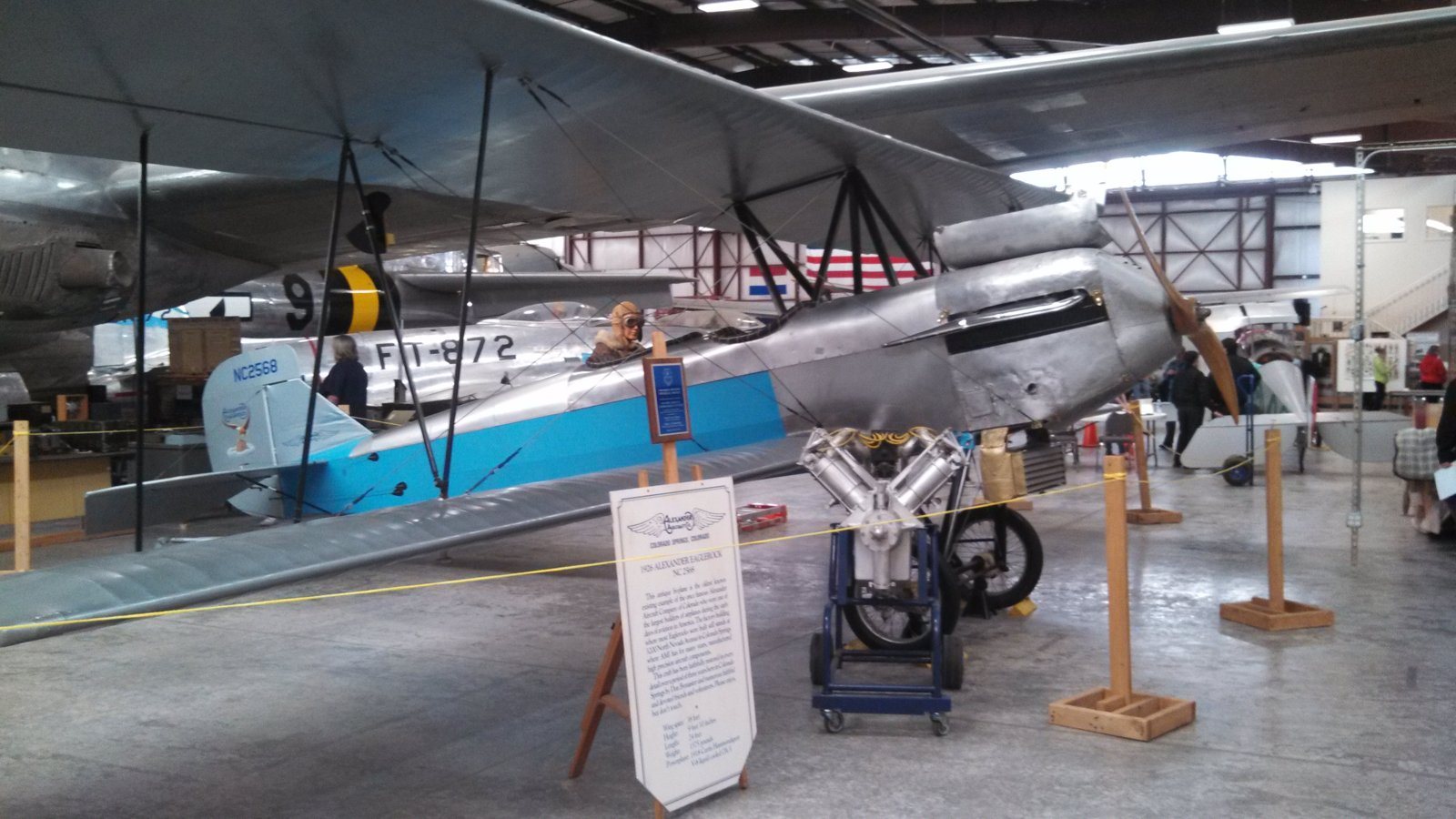
A Long Wing Eaglerock of the same type, NC2568, preserved in Colorado by the Colorado Aviation Historical Society, with its engine displayed beside it. Not our airplane. Photo by LanceBarber, Wikimedia Commons, CC BY-SA 3.0
Two Brothers and Fifty Airplanes
The Alexander Aircraft Company exists because two brothers could not buy what they wanted. J. Don Alexander and Don M. Alexander ran the Alexander Film Company of Englewood, Colorado, which made the short advertising films that played in movie theaters before the feature, and at one time made more of them than anyone else in the world. Their salesmen covered the country by train and by car. J. Don decided they could cover far more of it by air, and he wrote to the established manufacturers asking them to quote on fifty airplanes. As the company told the story afterward, nobody took the letter seriously. So the brothers decided to build their own.
They began with a used Swallow bought from the Nicholas-Beazley company of Marshall, Missouri, and the young man sent to fetch it learned to fly there in the process. The first airplane of Alexander’s own design flew in September 1925, overheated, and was never repeated. Its name lasted. The factory hands had been nursing an injured golden eagle as a shop pet, and someone put the eagle together with the Rocky Mountains outside the windows. Eaglerock.
The airplane that made the name famous was a three-seat open-cockpit biplane with a welded steel-tube fuselage, wooden wings and a war-surplus Curtiss OX-5, first flown in January 1926. The Long Wing was certificated by the Department of Commerce on April 27, 1927, as Approved Type Certificate Number 8, which puts it among the first ten airplanes ever type-certificated in the United States. It sold for $2,750.
Then the Lindbergh boom arrived, and Alexander caught it at full speed. For a short time in 1928 and 1929 the company was building as many as eight airplanes a day, more airplanes were being built in Colorado than anywhere else in the country, and by several accounts Alexander was the largest aircraft manufacturer in the world. It was not all triumph. In April 1928 a fire in the dope shed of the crowded Englewood plant killed eleven workers, and the company moved to a new factory at Colorado Springs that same year. The Depression ended the big-biplane market almost overnight, and Alexander’s aircraft business went bankrupt in 1932, after roughly 895 Eaglerocks had been built.
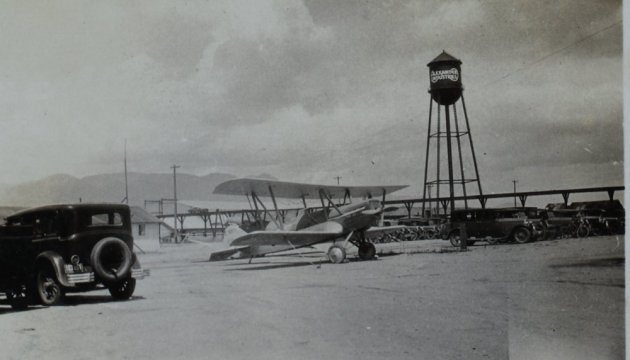
The Alexander Industries plant at Colorado Springs in the late 1920s; the water tower carries the company name. San Diego Air & Space Museum Archives, Jose Torre-Bueno album. No known copyright restrictions.
Al Mooney at Twenty
The design work that turned the Eaglerock into a best seller belongs largely to a red-haired kid from Denver named Albert Mooney. He was born in April 1906, had been studying airplanes since he was twelve, and started out sweeping the Alexander hangar after school. In 1925, at nineteen, he signed on as a draftsman. Within a year he was effectively the company’s engineer, and the Long Wing Eaglerock was his first airplane to reach production. He was about twenty when he drew it.
He went on to design the Alexander Bullet, a low-wing cabin monoplane with retractable landing gear that was years ahead of its market, and in 1929 he left to start the first Mooney Aircraft Corporation in Wichita. That company did not survive the Depression. He worked at Bellanca, then designed the Dart for Monocoupe and followed it to Culver, where it grew into the Culver Cadet. After the war came the little Mooney Mite and then the four-seat Mooney M20, still built in Kerrville, Texas, generations later. By the end of his career he was one of the best-known general aviation designers of the twentieth century. We have his Culver Cadet in the hangar too, and the two airplanes side by side are as close as we can come to showing a designer growing up.
Where This Airplane Has Been: Barnes Airport, 1928
Everything above is the story of the type, and it belongs to every Eaglerock. What follows belongs to this one. Serial number 547 was sold new in June 1928 to the Massachusetts Airways Corporation, a young commercial operator flying out of Barnes Airport at Westfield, near Springfield, a municipal field that had been dedicated in October 1923. The airplane carried passengers and property for hire, which in 1928 meant rides, charters and anybody who wanted to see the Connecticut River valley from the air.
Its first private owner did not keep it long. James L. Griffin of Holyoke bought it on July 28, 1928, and seventeen days later sold it back to the airline. We will never know what happened in those two and a half weeks, and we have enjoyed guessing. Massachusetts Airways sold it again in May 1929 to Edward J. Sullivan of West Springfield, who sold it in July 1930 to a Holyoke partnership of Charles G. Moore and Robert B. Boys. From them it went to Barnes Flying Service, the operator on the same field, which flew it under a full commercial license into the early Depression.
In the mid-1930s the airplane moved up the valley. Buford R. Dake of Montague owned it next, and then Charles Arthur St. Clair Dunham of Amherst, who flew it for pleasure. Dunham’s ownership is the best documented period in the whole file, because the Bureau of Air Commerce inspected the airplane every year he had it. The inspector’s forms from July 1934 and September 1935 survive, they record a clean standard airplane with the Curtiss OX-5 on the nose, and every one of them reads Approved. Not one form in the file records an accident.
West to Lake Michigan
In 1936 the Eaglerock left New England for good. It went first to Central Air Service of Grand Rapids, Michigan, and in August 1936 to Raymond Arthur Duffy of Benton Harbor, on the Lake Michigan shore. From Duffy it went around the bottom of the lake to Martin Rintz of Chesterton, Indiana, near the dunes, and later to Walter A. Kieper of Michigan City, who registered it with the Civil Aeronautics Administration in January 1949.
In the late 1950s it went to Elkhart Flying Service of Elkhart, Indiana, which registered it in 1958. In December 1970 the federal government revoked that registration because nobody had filed the activity report the agency asked for, which is how a great many old airplanes quietly disappeared from the records in those years. In forty-two years the Eaglerock had belonged to more than a dozen people and companies in three states. Then it went quiet.
Fifty-Five Years Off the Register
Somewhere in those quiet years, someone decided to bring the Eaglerock back. About fifty years ago its OX-5 was overhauled, and a restoration of the airframe was begun. It was never finished. When the airplane surfaces again in the record, it is in Louisville, Kentucky, with Central American Airways Flying Service at Bowman Field, one of the oldest airports in the country, whose president was Wilbur Lee Paris. The company transferred the airplane to Mr. Paris personally in 2018, and in 2025 he put it back on the federal register, fifty-five years after it had dropped off. He then gave it to the Collection, together with its Curtiss OX-5.
There is a hole in this story, and we would rather show it than paper over it. Nothing in the federal file tells us how the Eaglerock got from Elkhart to Louisville, who began that restoration fifty years ago, or where it spent the 1970s and 1980s. If you know, or if you have a photograph of this airplane at any time in its life, we would very much like to hear from you. We have not found a single picture of N5910 from its flying years.
Three Ways an Antique Airplane Arrives
People are often surprised to learn how differently old airplanes come to a museum. Some arrive nearly complete. Our 1935 Waco YMF was like that: when its parts had been reconstructed, we had most of what we needed to put it back together. Some arrive with almost nothing. Our 1936 Waco ZPF-6 came to us as, quite literally, a piece of paper and half a fuselage that is good only as a pattern, and every single part on that airplane is being built.
The Eaglerock is the third kind. It came as a pile of parts, and a fairly complete one. We have the fuselage, the wings, the engine, the axles and all kinds of fittings. What we do not have is an airplane. We have a puzzle, and somebody has to put it back together.
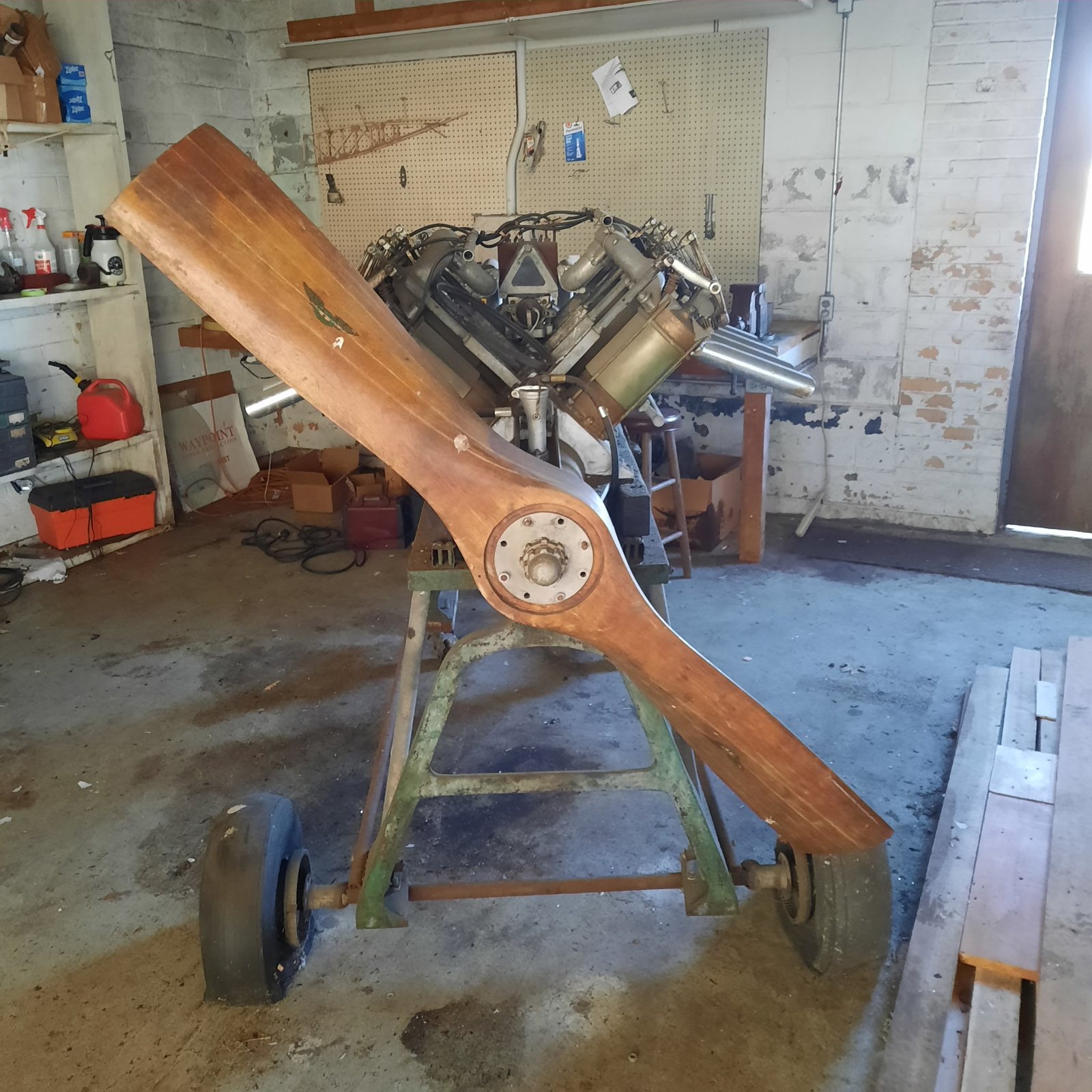
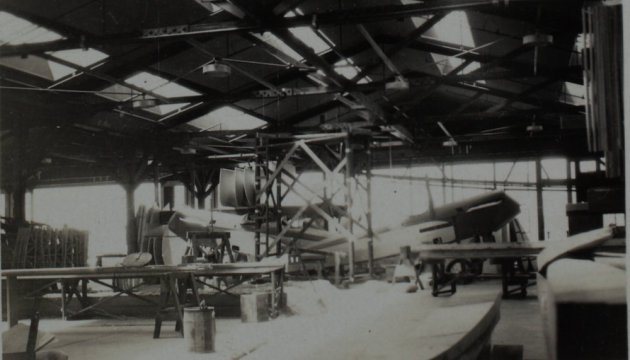
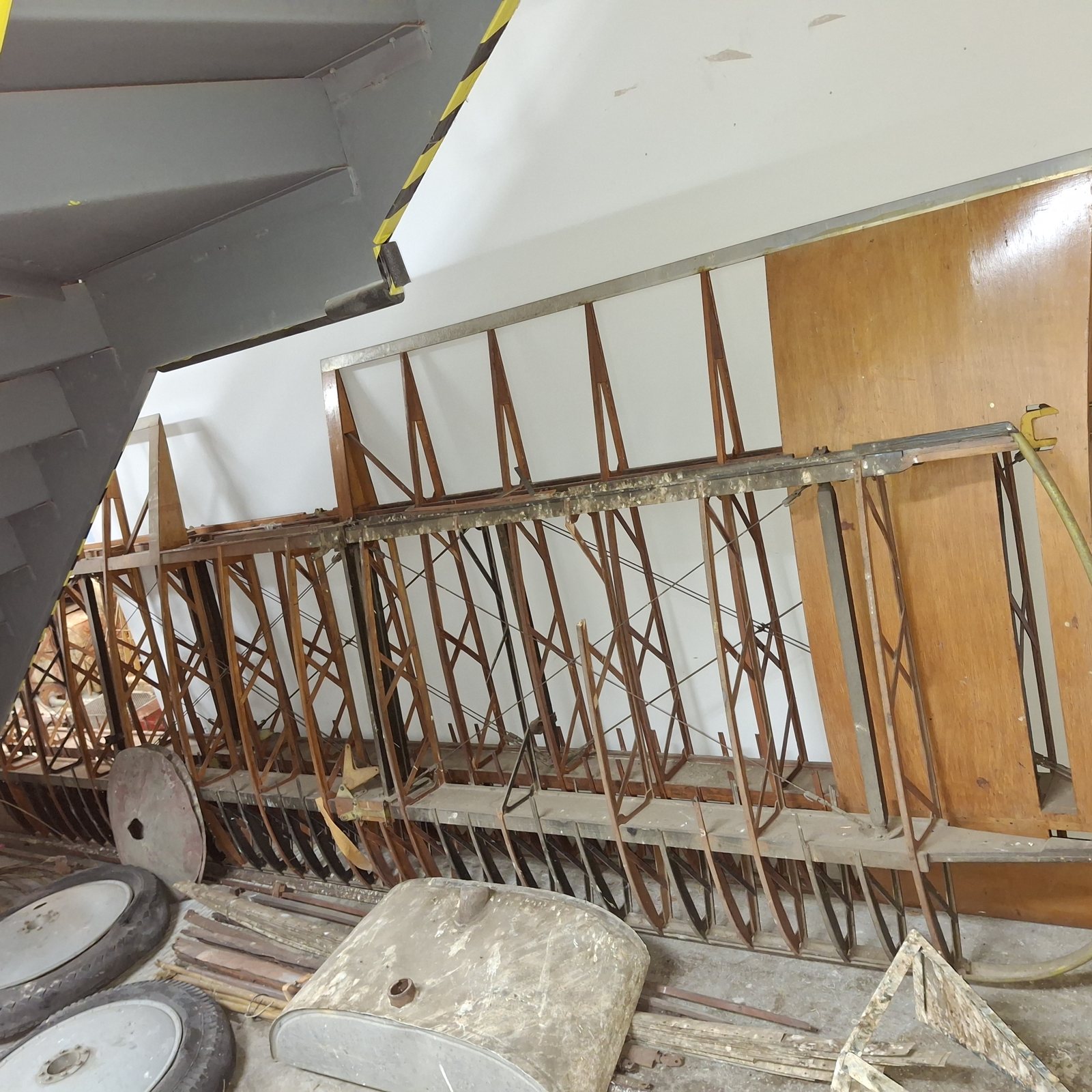
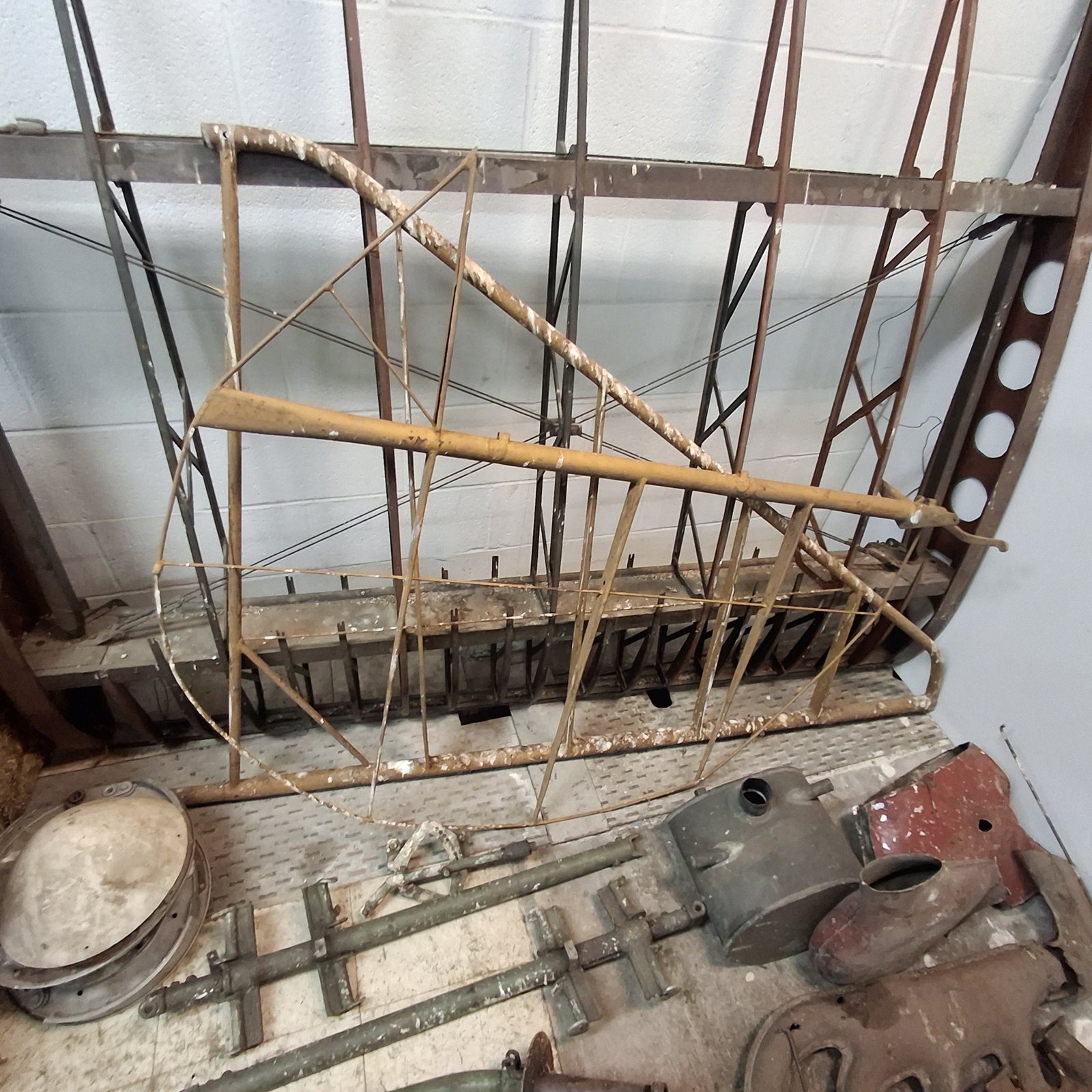
Inside an Alexander factory building, late 1920s, with airframes under construction. San Diego Air & Space Museum Archives, Jose Torre-Bueno album. No known copyright restrictions.Our Eaglerock as it came to us: wing panels, wheels and fittings from a restoration begun about fifty years ago. The Caldwell Collection
The Puzzle
In the early days of a project like this one, most of the work does not look like building an airplane at all. It is cleaning, straightening and evaluating every piece. It is making usable copies of parts that are too far gone to fly. It is overhauling the engine. And it is the beginning of a long search around the world for everything that is missing: wheels, bearings, hard-to-find engine parts, hoses to be made, landing gear fittings to be machined.
There are a thousand things that were ordinary in the 1920s, available from a catalog or a hardware store, that simply do not exist anymore and have to be recreated. Then there are the parts the factory made for itself, unique to a small company with a small production run that has been out of business for nearly a hundred years. If you are lucky, there is a drawing or a specification somewhere, at the Smithsonian Institution or in somebody’s files. If you are not, you have to work the part out from scratch.
Even the earlier restoration is part of the puzzle. The parts that were made for this airplane fifty years ago have deteriorated in their turn. They are invaluable as patterns, but they cannot go into a flying airplane. The engine tells the same story. The OX-5 that came with the airplane is in remarkably good condition, and it was overhauled fifty years ago, but fifty years is a long time. Mechanical things that are not used deteriorate, and it has to be overhauled again.
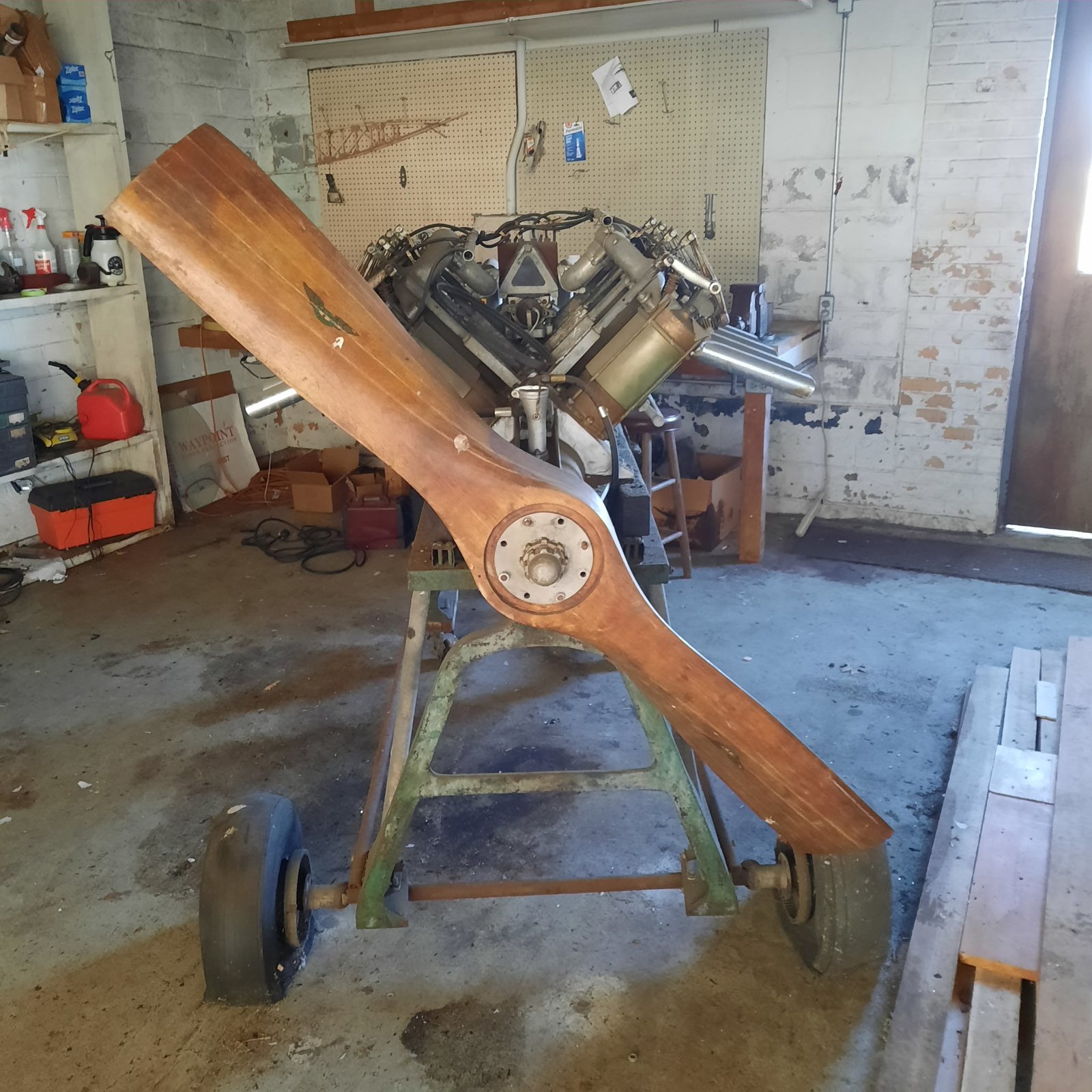
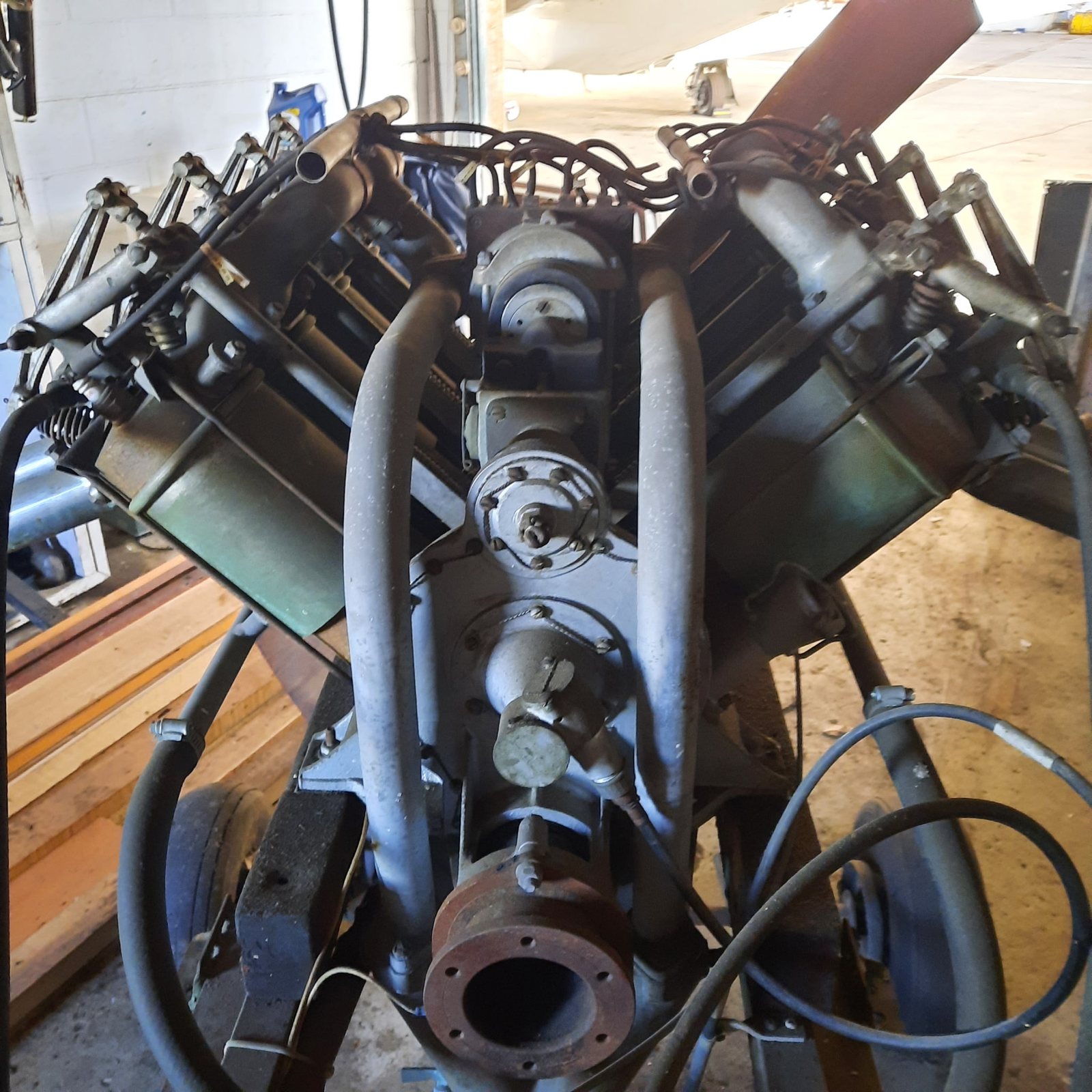
The Eaglerock’s own Curtiss OX-5, which came to the Collection with the airplane. The Caldwell Collection
John Gaertner and Blue Swallow
The Eaglerock is being restored by John Gaertner at Blue Swallow Aviation in Free Union, Virginia. John has spent his life around early airplanes. He has been a research assistant at the Smithsonian’s National Air and Space Museum and curator of the EAA Museum at Oshkosh, his shop has returned five Curtiss Jennies to flying condition, and he has overhauled a string of OX-5 engines. There are very few people anywhere who know this generation of airplane, and this engine, as well as he does.
In the beginning, the restoration has meant John driving long distances to sit down with people who have done this before, and our Chairman writing a great many emails to anyone who might have restored an Eaglerock in the past, asking whether they have drawings we could borrow. Even drawings for a different model can help. At the same time we have been researching what this airplane once was, through its federal file and everything else we can find. And while all of that goes on, the shop is cleaning and beginning to make the things the airplane needs, by the ones and the tens and the hundreds.
That is why it takes thousands of hours to build an airplane out of memory, archives and experience. John is sorting, piecing together and sourcing, patiently, methodically and carefully, and soon the building begins. We think the Long Wing will take about three years.
Follow the Restoration
The whole idea of the Caldwell Collection is airplanes that fly. A project goes into the shop with one purpose, which is to come back out flying. While this one is in Virginia, we will post regular updates here: what John is working on, what we have found, what we are still looking for, and photographs of the work as it goes. Check back, and if you have drawings, parts or knowledge of Eaglerocks, please get in touch.
Restoration Journal
Research
Where We Start: A Pile of Parts
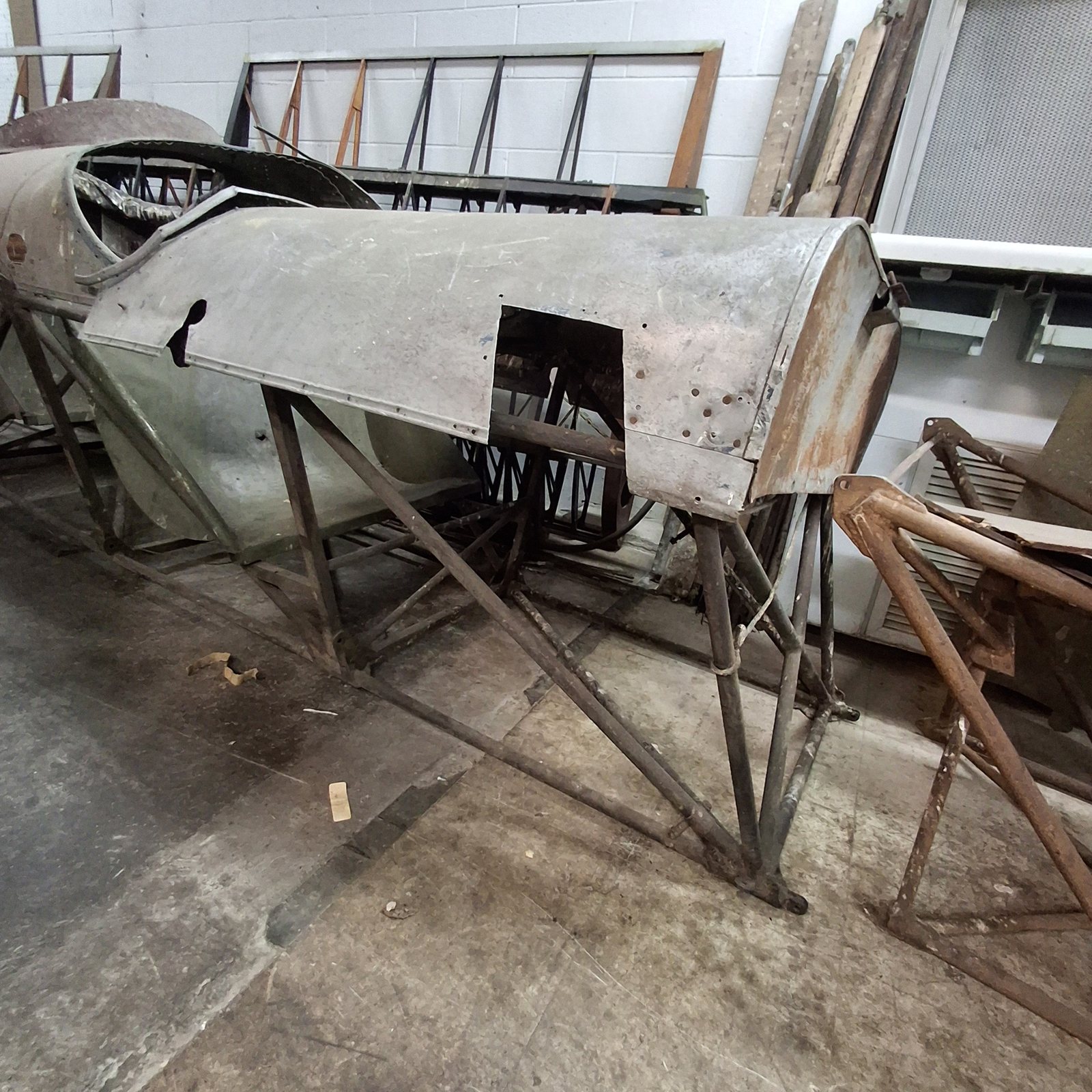
The Eaglerock arrived as a fairly complete pile of parts: fuselage, wings, the Curtiss OX-5, axles and a great many fittings. John Gaertner's first job at Blue Swallow has been to clean, straighten and evaluate every piece, and to sort what can fly from what can only serve as a pattern.
The OX-5 turned out to be in remarkably good condition. It was overhauled about fifty years ago, and it will be overhauled again now, because fifty years of sitting is hard on any machine. Parts from an earlier restoration of the airframe, begun about the same time, have also deteriorated and will be used as patterns.
Meanwhile the hunt is on for drawings and for the parts nobody makes anymore. If you have restored an Eaglerock, or have drawings for any Alexander model, we would love to hear from you.
The welded steel-tube fuselage, as it came to us. Photo: The Caldwell Collection.A wing panel frame and fittings. Photo: The Caldwell Collection.Looking down on the OX-5's two banks of cylinders. Photo: The Caldwell Collection.
Two famous stories attach to the Eaglerock as a type, and we tell them here because they are wonderful, with the plain statement that neither of them happened to this airplane. In the fall of 1932 James Herman Banning and Thomas Cox Allen flew an Eaglerock from Los Angeles to New York, the first transcontinental flight by African American pilots, on almost no money and a great deal of help from the people they met along the way. And in the company’s own telling, a young airmail pilot named Charles Lindbergh came to see J. Don Alexander late in 1926 about a modified Long Wing for an attempt on the Atlantic, and was turned away because the factory had too many orders to fill. He went to Ryan instead.
Our Eaglerock was in New England carrying passengers for hire while those stories were being made. Its history is quieter and entirely its own, and that is the history we put our name to.
When It Is Finished
The Eaglerock carries the Collection back toward the beginning of American civil aviation, to the years when the first purpose-built commercial airplanes were replacing worn-out war-surplus Jennies. It holds one of the very first type certificates the government ever issued. It brings the Curtiss OX-5, the engine of the barnstorming years and the only one in our hangars, into the Collection. And it is the first chapter of Al Mooney’s career, with the Culver Cadet as a later one, so that visitors can see what a gifted designer drew at twenty and what he drew in his thirties.
“When it is finished, this airplane will be a remarkably rare survivor from a company that, for a brief time in the 1920s, was one of the world’s major makers of airplanes, a company started by two brothers because no one would sell them the fifty airplanes they wanted for their salesmen. It will show the world once again the genius of a young man who found himself sweeping the Alexander Aircraft hangar after school, and who went on to become one of the most famous general aviation designers of the twentieth century, Al Mooney. It will be a remarkable achievement when John, with a little help from me, is finished.”
Donated to The Caldwell Collection at Mustang Field by Wilbur Lee Paris of Louisville, Kentucky. Restoration by John Gaertner, Blue Swallow Aviation, Free Union, Virginia.
IN RESTORATION AWAY FROM THE FIELD
The 1928 Alexander Long Wing Eaglerock is in the shop in Virginia
This airplane is being restored at John Gaertner’s Blue Swallow Aviation in Free Union, Virginia, so you won’t see it on a visit to Mustang Field yet. Follow the work in the Restoration Journal above. In the meantime, the rest of the Collection is in the hangar Tuesday–Friday 10am–4:30pm and Saturday 10am–2pm. Admission is free.
Al Mooney’s design from the end of the 1930s, the later chapter of the same designer’s career. A wooden two-seat low-wing monoplane with retractable gear, and as different from the Eaglerock as two airplanes by one man can be. Same designer: Al Mooney
A 1932 airplane from Marshall, Missouri, the town where Alexander bought the used Swallow that started its aircraft business and where Al Mooney worked briefly in 1926.