Charles L. Lawrance
1882–1950
The Paris-trained architect who gave America the air-cooled radial
The engines that carried airplanes across the Atlantic and out to Hawaii in 1927 came from a man trained to design buildings. Charles Lanier Lawrance was born in Lenox, Massachusetts, on September 30, 1882, into a prominent New York family. He attended Groton School and graduated from Yale in 1905. After an automobile venture failed in the Panic of 1907, he went to Paris, where he studied architecture at the École des Beaux-Arts, taking his diploma in 1914, and experimented in aeronautics at the Eiffel laboratory.
In France in 1913 he developed the Lawrance-Moulton V-8 racing engine. Back in the United States, he founded the Lawrance Aero Engine Company in New York City in 1917 and kept at his work while serving in the Navy. His first air-cooled engine, the two-cylinder A-3, was built by the hundreds for military training craft, and his three-cylinder L-series radials followed.
In 1920 the Army gave Lawrance a contract for a nine-cylinder radial using the L-series cylinders, and the Navy ordered a larger version. That engine, the J-1, made 200 horsepower, weighed 476 pounds, and passed its first 50-hour test in 1922. On October 8, 1922, at the Curtiss Marine Trophy Race in Detroit, only one of eight Navy seaplanes finished, and it was powered by a J-1. The Navy doubted that Lawrance's small company could build enough of them and pressed the Wright Aeronautical Corporation of Paterson, New Jersey, to buy it. Wright did so in May 1923 and made Lawrance a vice president. In 1925, when Frederick Rentschler left to found Pratt & Whitney, Lawrance became Wright's president.
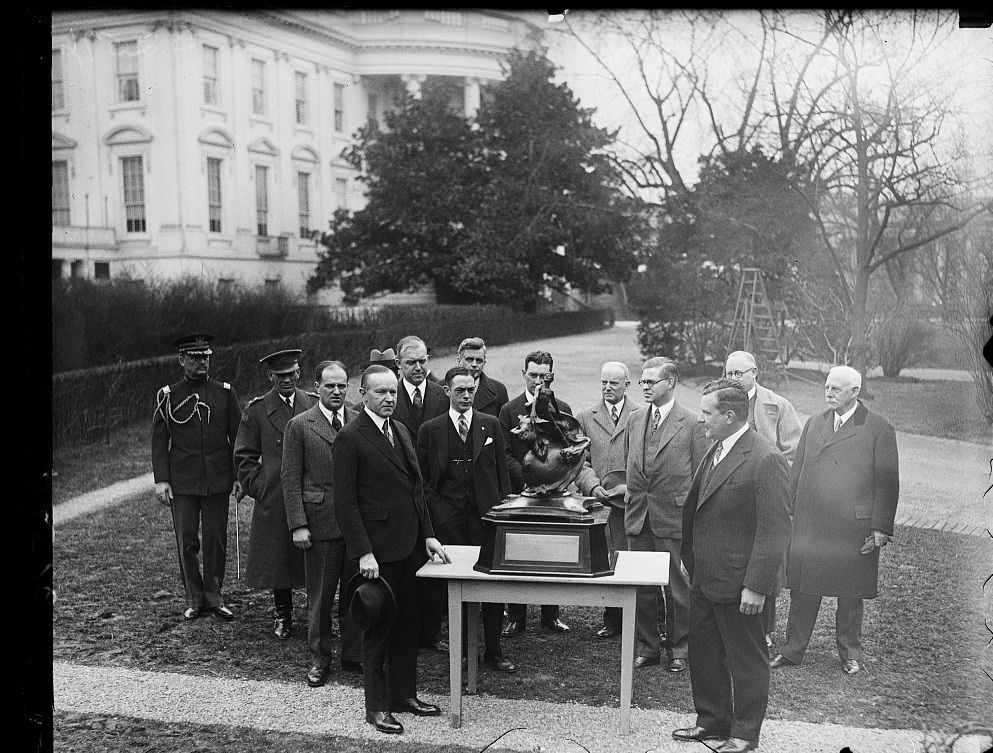
At Wright the J-1 grew into the J-4 Whirlwind of 1924 and the J-5 of 1925. In 1927 J-5 engines powered Charles Lindbergh's *Spirit of St. Louis* to Paris, Clarence Chamberlin and Charles Levine to Germany, and the Army's Lester Maitland and Albert Hegenberger to Hawaii. The 1927 Collier Trophy went to Lawrance "for the development of the air-cooled aircraft radial engine," and President Coolidge presented it on the White House lawn in March 1928. That year Wright introduced the J-6 Whirlwinds in five-, seven- and nine-cylinder sizes.
After the 1929 merger that created Curtiss-Wright, Lawrance was a vice president until he resigned in 1930. He founded the Lawrance Engineering and Research Corporation, later the Lawrance Aeronautical Corporation, in Linden, New Jersey, which built auxiliary power plants for aircraft during the war. He was elected president of the Aeronautical Chamber of Commerce in 1931 and published *Our National Aviation Program* in 1932. He retired in 1948 and died at Meadow Farm, his home in East Islip, Long Island, on June 24, 1950. He is buried in Locust Valley Cemetery, and his papers are at the University of Wyoming's American Heritage Center.
A Wright Whirlwind R-760, the seven-cylinder J-6, is on display in our hangars, and the same engine type flies in two of the Collection's airplanes. Our 1931 Curtiss-Wright Travel Air B-14-R Speedwing originally flew behind a nine-cylinder Wright R-975-E2 Whirlwind rated 420 horsepower. Today it carries a Pratt & Whitney R-985, built by the company Rentschler left Wright to found.