Clyde V. Cessna
1879–1954
The monoplane man from the Salt Plains
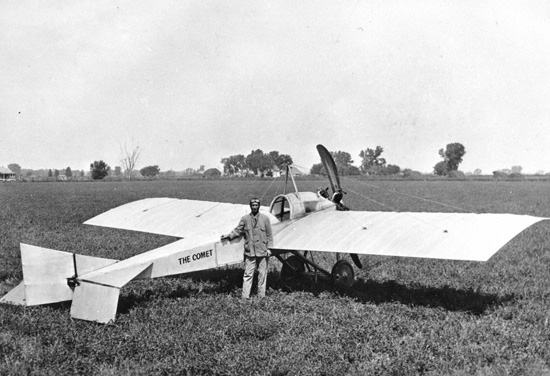
Before Wichita, Clyde Cessna's story belongs to Oklahoma. He was born on December 5, 1879, in Hawthorne, Iowa, and grew up on a farm near Rago in Kingman County, Kansas. By 1910 he was managing the Overland automobile dealership in Enid, Oklahoma. In 1911 he watched the Moisant International Aviators fly at Oklahoma City, sold the dealership, and came home from the Queen Aeroplane Company in New York with a Blériot-type monoplane, which he and his brother Roy fitted with an engine and named Silverwing. On the Great Salt Plains near Jet, Cessna taught himself to fly through one crash after another, and on December 17, 1911, he flew five miles near Enid and landed where he had started. For six years he made his living flying exhibitions in Oklahoma and Kansas, and in 1916 he built the first airplanes made in Wichita.
Late in 1924 Walter Beech and Lloyd Stearman, who had left the Swallow company, turned to their friend Cessna for help starting a new firm. Travel Air was organized in Wichita in January 1925, and Cessna was its president by spring. Travel Air built biplanes, but Cessna believed in the monoplane. A cabin monoplane he designed flew at the Travel Air field in June 1926 and, reworked with Stearman, became the basis of the Travel Air 5000. He wanted to go further, to a full-cantilever wing with no struts at all, and when Beech would not agree, Cessna sold his Travel Air stock in January 1927.
In September 1927 he and Victor Roos formed the Cessna-Roos Aircraft Company. Roos soon left, and by December it was the Cessna Aircraft Company. Its cantilever Model A cabin monoplanes, the AW above all, sold well, followed by the DC-6 of 1929. Then the Depression erased the market. In March 1931 the directors, who had already demoted Cessna to vice president, closed and locked the factory and took everyone, Cessna included, off the payroll. Shut out of his own plant, he and his son Eldon built racers in a shop of their own: the CR-2 "Miss Wanda" in 1932 and the CR-3, which won every race Johnny Livingston flew it in during 1933. When his friend Roy Liggett was killed in the CR-2 that year, Cessna lost heart for the business.
His nephew Dwane Wallace and Dwane's brother Dwight won control of the company at the stockholders' meeting of January 17, 1934, and the new board made their uncle president again. Dwane's C-34 put Cessna back on its feet, and in 1936 Clyde Cessna retired to his farm near Rago. He died there on November 20, 1954, at 74, and is buried in Greenwood Cemetery in Kingman County. The National Aviation Hall of Fame inducted him in 1978.
Two airplanes in The Caldwell Collection at Mustang Field come from the company he helped found and first led: our 1929 Travel Air B4000, and the 1927 Travel Air 3000 now on its way to Mustang Field. Both were built after he left to chase his monoplane, but they carry the name he lent his money and reputation to in 1925.
Our airplanes from this story
- 1927 Travel Air 3000 NC1084
- 1929 Travel Air B4000 N13906
Part of the story told in The Founders’ Tree, the founders posters in the museum.