Edward Vernon "Eddie" Rickenbacker
1890–1973
Race driver, America's ace of aces, and the man who built Eastern Air Lines
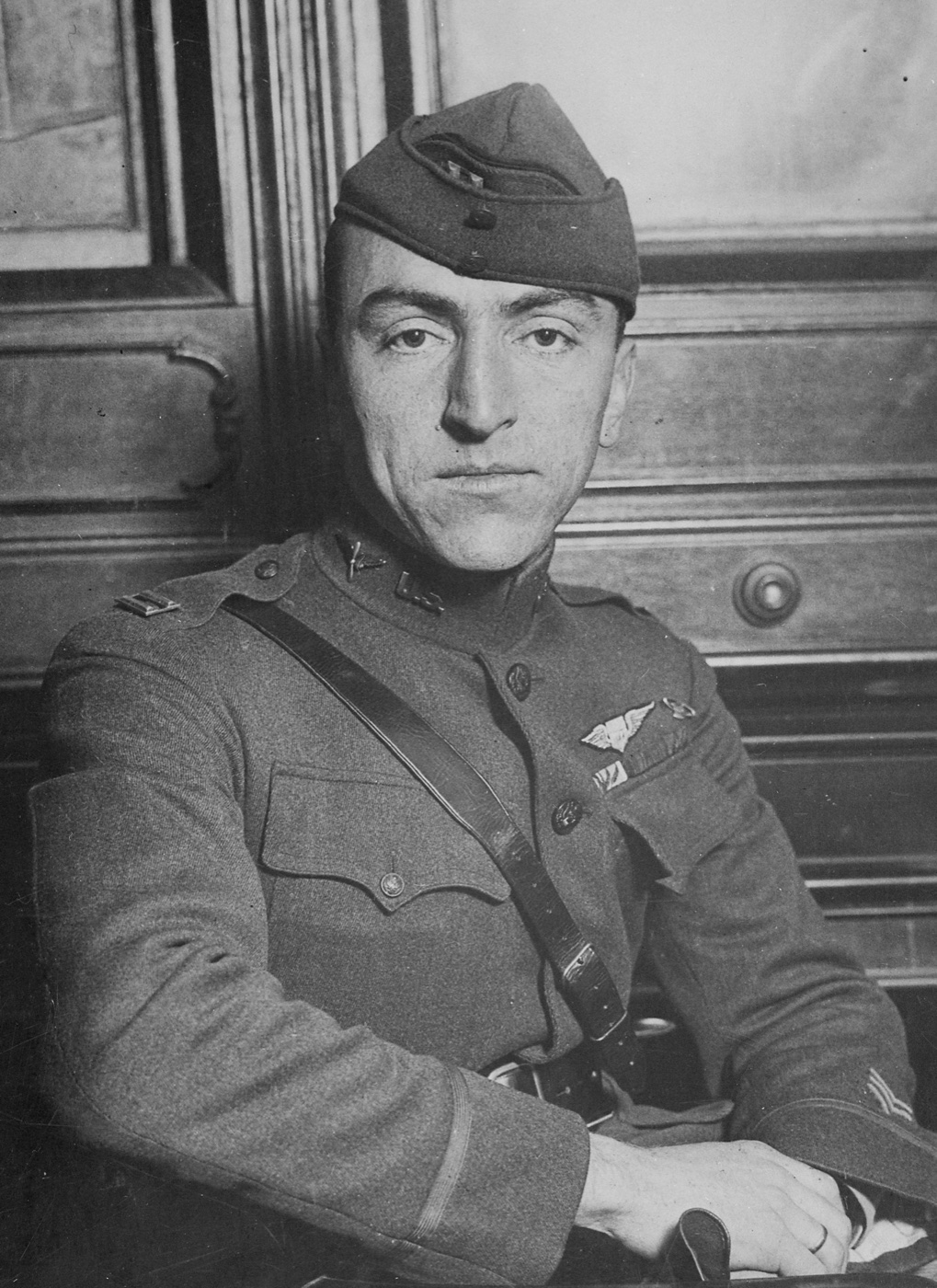
Few Americans lived as many lives as Eddie Rickenbacker, and our hangars touch three of them. He was born on October 8, 1890, in Columbus, Ohio, the third of eight children of Swiss immigrants. When his father died he left school at twelve and went to work. At about fifteen he went to work for the automobile builder Lee Frayer, rode as his mechanic in the 1906 Vanderbilt Cup elimination race, and followed him to the Columbus Buggy Company.
Racing made him famous. He was Frayer's relief driver in the first Indianapolis 500 in 1911 and started the race himself in 1912, 1914, 1915 and 1916, with his best finish, tenth, in a Duesenberg in 1914. By 1916 he ran his own team of Maxwells.
When America entered the First World War he enlisted as a sergeant and driver. He is often called General Pershing's chauffeur, and he was recruited for that job, but he mostly drove for Major Townsend Dodd and then for Colonel Billy Mitchell, who approved his transfer to pilot training. He joined the 94th Aero Squadron, the "Hat in the Ring" squadron, and scored his first victory on April 29, 1918. On September 25 he took command of the squadron and, flying alone near Billy, France, attacked seven German airplanes and shot down two. He finished the war credited with 26 victories, the leading American ace, and on November 6, 1930, President Hoover presented him the Medal of Honor for that September fight.
In 1922 the Rickenbacker Motor Company of Detroit put cars bearing his name and his squadron's emblem on the market, with Rickenbacker as vice president and sales director. In 1923 it fitted four-wheel brakes to all its cars, among the first medium-priced American makes to do so, but rivals fought the idea and the company failed in 1927. That November he took control of the Indianapolis Motor Speedway, which he ran until he sold it to Anton Hulman Jr. in 1945. He became general manager of Eastern Air Lines in 1935, and in April 1938 he and his associates bought it for $3.5 million. He was badly hurt in the crash of an Eastern DC-3 near Atlanta on February 26, 1941. In October 1942, on a Pacific mission for the Secretary of War, his B-17 ditched at sea, and he and his companions drifted 24 days in rafts before rescue; one man died. He became Eastern's chairman in 1953 and retired at the end of 1963.
Rickenbacker died of pneumonia in Zurich, Switzerland, on July 23, 1973, and his ashes rest beside his mother at Green Lawn Cemetery in Columbus. His papers are at Auburn University.
Our 1925 Rickenbacker D6 Touring car carries his name and his Hat in the Ring. Our 1928 Stearman C3MB and 1931 Stinson Junior S come from the airmail and early airline era whose industry he went on to lead, and Charlie Meyers, designer of our 1930 Great Lakes 2T-1A, flew for Eastern for twenty-five years. The original Étienne Dormoy Bathtub, the airplane behind our 1923 Dormoy Bathtub reproduction, is credited with winning the Rickenbacker Trophy at the 1924 National Air Races in Dayton.
Our airplanes and car from this story
- 1925 Rickenbacker D6 Touring car
- 1928 Stearman C3MB N6487
- 1931 Stinson Junior S NC10852
- 1930 Great Lakes 2T-1A N822K
- 1923 Dormoy Bathtub reproduction N568AL