William O. Warner
born 1891
The Curtiss draftsman who designed the Scarab and ran the company that bore his name
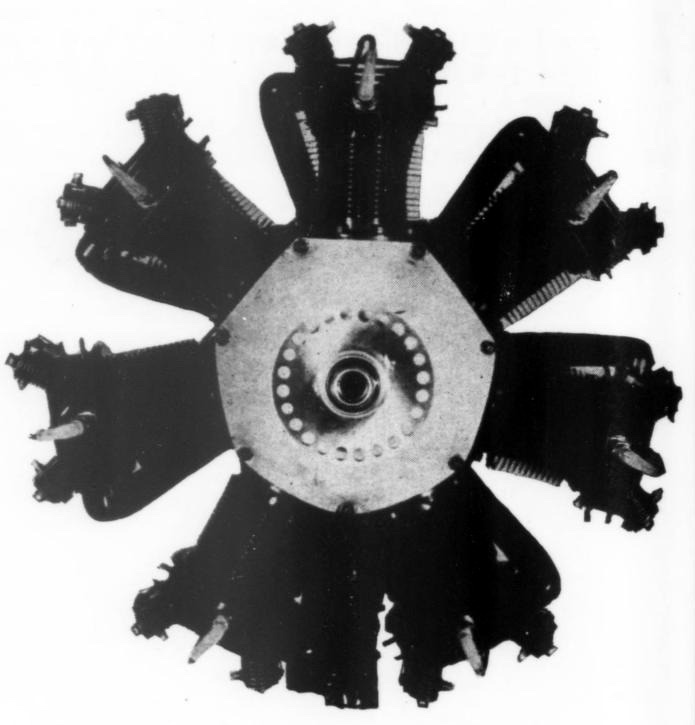
Many airplanes in our hangars fly behind a Warner, and the name on the crankcase belongs to a real man. William O. Warner was born on October 10, 1891, in St. Johns, Pennsylvania, the son of John F. and Ida Mace Warner. In 1914 he went to work as a draftsman for the Curtiss Aeroplane and Motor Company, and he married Florence M. Coolbaugh in 1916. After a year as an engineer with the Army's air arm in 1919 and 1920, he went back to Curtiss until 1925.
In Detroit, Warner found backers among the city's industrialists. A group that included Charles B. Bohn, head of the Bohn Aluminum and Brass Corporation, and William B. Mayo, chief engineer of the Ford Motor Company, organized the Warner Aircraft Corporation on October 20, 1926, and that same month Warner began designing a small seven-cylinder radial. The first engine was built in Bohn's shops, with cylinder heads of Bohn aluminum alloy. After stand tests in 1927 it flew in a Travel Air biplane. The company was organized formally after the tests, with the bearing manufacturer Newton Skillman as president and Warner as vice president and chief engineer. In 1928 the Scarab became the second commercial engine approved by the Department of Commerce. Rated at 110 horsepower, it sold for $2,245, and the first production engines went into the Stinson Junior and the Buhl Junior.
The Scarab arrived as builders sought a modern replacement for the war-surplus Curtiss OX-5, and Scarab-powered airplanes took the first four places in Class A of the 1928 National Air Derby from New York to Los Angeles. Sales rose from 85 engines in 1928 to about 300 in 1929, and by January 1929 Warner was president. The Scarab grew to 125 horsepower, and Warner Aircraft added the five-cylinder Scarab Junior in 1930 and the larger Super Scarab in the early 1930s at 145 horsepower, certificated at 165 horsepower in 1939. Warners powered the Monocoupe 110, Fairchild 22 and 24, Waco RNF and Cessna Airmaster. From 1932 the company also built wheels, brakes and struts, and its chief engineer was Ludwig A. Majneri, an Austrian-born engineer who, like Warner, had come from Curtiss.
In 1940 the British ordered about 250 Super Scarab 165s for Australia's Wackett trainers, the company's largest order. In uniform the Super Scarab became the R-500, which powered the Fairchild UC-61 Forwarder, and its 185-horsepower growth became the R-550. The first Sikorsky XR-4 flew with a Warner on January 14, 1942, and production R-4s, the first helicopters built in quantity, used the R-550. In 1950 the stockholders sold the company's assets to the Clinton Machine Company of Clinton, Michigan, and Warner Aircraft became the Warner Division, by then making hydraulic valves. We have not yet found when or where William Warner died.
Our 1930 Great Lakes 2T-1A has flown behind a Warner Super Scarab 165 since 1974, and our 1938 Ryan SCW-145 flies behind a Super Scarab 145. Our 1929 Fleet Model 1 and 1929 Lincoln-Page PT-W are registered with Scarabs, and our 1934 Fairchild 24 C8A and 1933 Fairchild 22 C7E are Scarab-powered models by design.
Our engines from this story
- Warner Scarab 110 hp
- Warner Scarab 125 hp
- Warner Super Scarab 145 hp
- Warner Super Scarab 165 hp
- Flies in: 1930 Great Lakes 2T-1A N822K
- Flies in: 1938 Ryan SCW-145 NC18916
- Flies in: 1929 Fleet Model 1 N607M
- Flies in: 1929 Lincoln-Page PT-W N561M
- Flies in: 1934 Fairchild 24 C8A N957V
- Flies in: 1933 Fairchild 22 C7E N9395