Henry Ford
1863–1947
The carmaker whose engine flew the Air Camper and whose name flew on the Trimotor
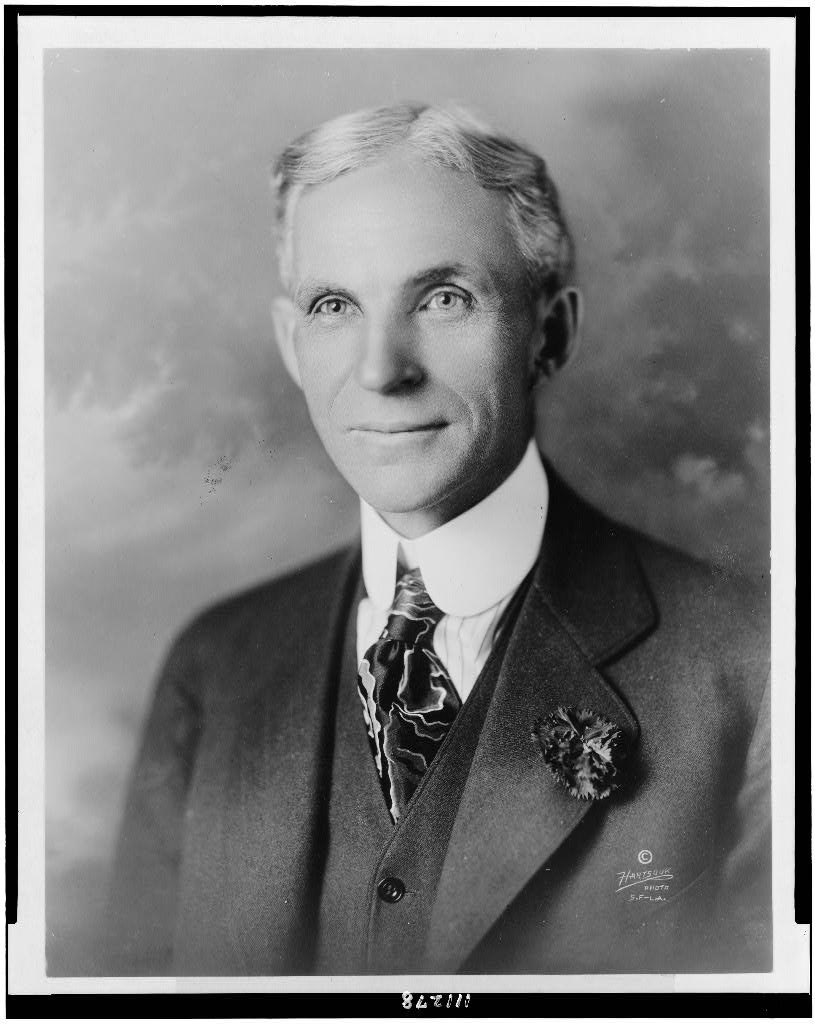
Henry Ford was in his sixties before he ever went up in an airplane, yet for eight years his company was one of the biggest names in American aviation, and the engine of his family car showed a Minnesota mechanic that anyone could build an airplane. Ford was born on July 30, 1863, on his family's farm in what is now Dearborn, Michigan. He trained as an engineer with the Edison Illuminating Company of Detroit, drove his first car in 1896 and founded the Ford Motor Company in 1903. His Model T arrived in October 1908, and about 15 million had been built when production ended on May 26, 1927. Americans called it the "flivver," slang for a cheap car. Its successor, the Model A, was introduced on December 2, 1927, with a four-cylinder engine of 200.5 cubic inches that made 40 horsepower at 2,200 rpm.
Ford's son Edsel was an early investor in William Stout's Stout Metal Airplane Company. In April 1925 Ford began flying company freight between Dearborn and Chicago, and that year he laid out the Ford Airport in Dearborn, with FORD spelled across the field in 200-foot letters of crushed stone. In August 1925 he bought the Stout company outright. Its all-metal 4-AT Tri-Motor first flew on June 11, 1926, and 199 Ford Tri-Motors were built. More than a hundred airlines flew them. From 1925 to 1931 the company also sponsored the Ford Reliability Tours, run in Edsel's name, to prove commercial airplanes dependable. In August 1926 Walter Beech and his navigator, Brice Goldsborough, won the 2,585-mile tour in a Travel Air.
Ford also wanted an airplane for everyone. In 1926 the engineer Otto Koppen designed the Ford Flivver, a single-seat monoplane with a 35-horsepower Anzani engine, built at Ford's request to fit inside his office. In February 1928 test pilot Harry Brooks flew a Flivver 972 miles, a light-plane distance record, and four days later he disappeared off the Florida coast. Ford halted the project. The Depression ended the rest, and the last Tri-Motors were delivered in May 1933.
Between 1920 and 1922 his weekly newspaper, the Dearborn Independent, ran a series of antisemitic articles, and in June 1927, facing a libel suit, he issued a public apology. Ford died at Fair Lane, his Dearborn estate, on April 7, 1947, the night a Rouge River flood had cut the house's power. He is buried in the Ford Cemetery on Joy Road in Detroit. His papers are at the Benson Ford Research Center of The Henry Ford in Dearborn.
The Ford Model A engine in our hangars is the type Bernard Pietenpol designed the Air Camper around, and our 2013 Pietenpol Air Camper was built from his plans. Our 1927 Travel Air 3000 and 1929 Travel Air B4000 come from the company whose airplane won Ford's 1926 tour, and our 1924 Ford Model TT grain truck came from his company in the Model T years. When the Collection calls its affordable airplanes flivvers, it is borrowing the nickname of his Model T.
Our engines from this story
- Ford Model A
- Flies in: 2013 Pietenpol Air Camper NX898H
- Flies in: 1924 Ford Model TT grain truck