Otto E. Szekely
The Budapest-born engineer behind the little Szekely radial
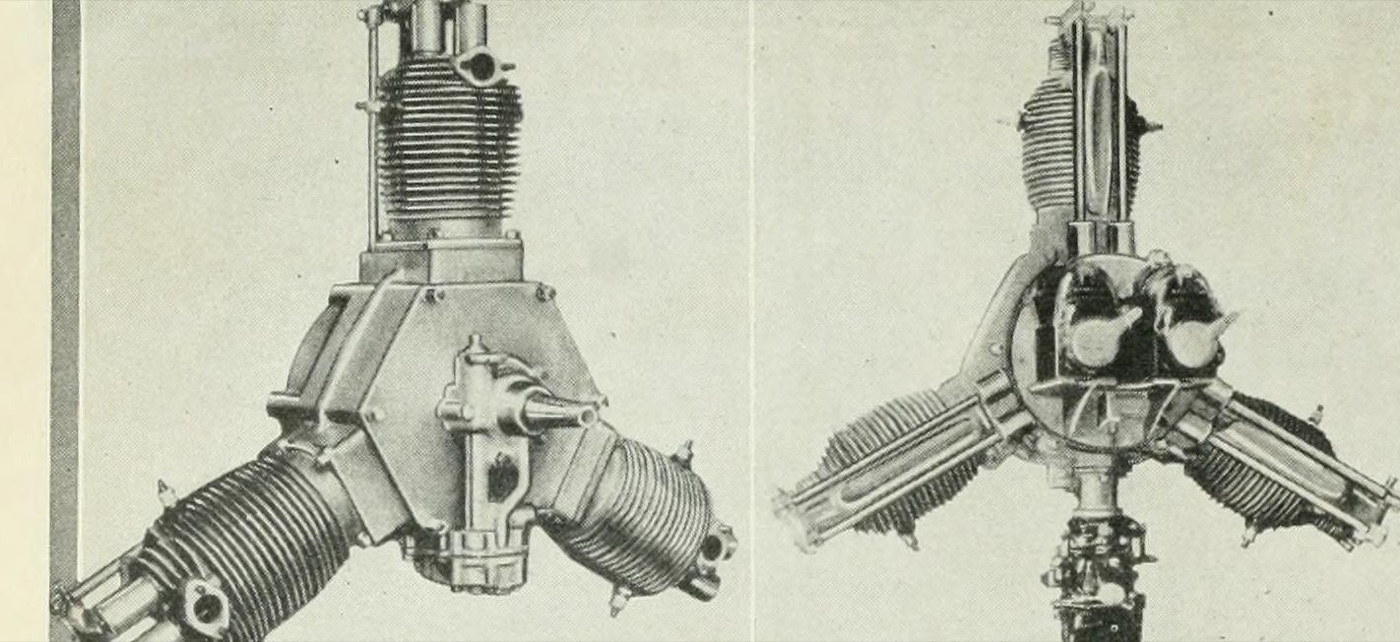
The three-cylinder radial on the nose of our Eaglet came from a factory in Holland, Michigan, a lakeside town settled by the Dutch, and from an engineer born in Budapest. Otto E. Szekely came to airplanes from automobiles and farm machinery. By 1919 he was chief engineer and production manager of the tractor department of the Velie Motors Corporation in Moline, Illinois, and the designer of Velie's kerosene-burning tractor. That June he left Velie to open his own engineering laboratory, the O. E. Szekely Company, in Rock Island. In 1925 he applied from Moline for a patent on a piston-ring spring.
In November 1926 Holland announced that Szekely would build a factory there to make dynamometers for testing automobile and aircraft engines. By early 1928 the O. E. Szekely Corporation, on the north side of Black Lake (now Lake Macatawa), was building a three-cylinder air-cooled radial called the Sky Roamer, soon known as the SR-3. In June 1928 *Aero Digest* reported that it displaced 190 cubic inches and was guaranteed to make 40 horsepower at 1,800 rpm. Szekely also bought the rights to a small single-seat monoplane, sold it as the Flying Dutchman, and gave Holland an airport, which opened in August 1928. Only 21 Flying Dutchmans were built. The renamed Szekely Aircraft and Engine Company settled on engines, and its later versions included the L-head SR-3-L of 30 horsepower and the overhead-valve SR-3-O of 45 horsepower, both approved by the Department of Commerce.
The SR-3 arrived just as cheap two-seaters became the light-airplane industry's hope against the Depression. By June 1931 the *Holland City News* counted six airplane builders using it, among them Curtiss-Wright, Buhl and American Eagle. It powered the Curtiss-Wright Junior pusher, the Buhl Bull Pup, the American Eagle Eaglet, the Rearwin Junior, the Alexander Flyabout and the Taylor H-2 Cub. Its reputation was mixed. Junior owners are said to have wrapped a steel cable around the cylinders so that one which worked loose could not reach the propeller turning behind the pilot, and many owners later swapped their Szekelys for Continental or Franklin engines.
Sales could not outrun the Depression. The company failed in 1932, leaving local investors with worthless stock. Its assets passed through several hands, and by 1938 Heath Aviation of Benton Harbor was supplying parts to the remaining owners. Szekely moved east. In May 1931 he had presented a paper on engines for light airplanes to the American Society of Mechanical Engineers in Baltimore, and in 1932 *Aero Digest* reported that he headed a new Szekely Engineering Corporation there. Holland's historian Robert Swierenga writes that he left for New York. When and where he died, and where he is buried, have not been confirmed.
Our 1931 American Eagle Eaglet 230, remarkably, still wears a Szekely SR-3, as it did when it was new. A second Szekely, from Ken and Lorraine Morris, is coming to the Collection for display.