Richard K. LeBlond
1864–1953
The Cincinnati lathe builder who put little radials in the air
Richard Knight LeBlond spent more than sixty years building lathes, and for nine of them his company also built one of the best-known lines of small airplane engines in America. He was born in Cincinnati on April 23, 1864, the eldest of five sons of Robert E. LeBlond, a printer. After leaving school he apprenticed as a machinist at the Franklin Type Foundry and then worked his trade in type foundries from St. Louis to Providence, Rhode Island.
In 1887, at twenty-three, he came home and opened a three-man shop making molds, gauges and small tools for type founders. A contract in 1891 to build lathes for another Cincinnati firm, Lodge & Davis, set the course of his life, and in 1892 he built the first lathe of his own design, a 14-inch engine lathe. The R. K. LeBlond Machine Tool Company grew steadily, moved to Eastern Avenue in 1897 and to a large new plant in Norwood in 1917 and 1918, and became known worldwide for its lathes, especially its crankshaft lathes for the automobile industry. He married Loretto Heekin on September 18, 1895, and they had four children: Harold, Loretto, Elizabeth and Richard.
The sources do not record why a lathe builder went into aviation, but the opportunity is clear. In the aviation boom of 1928, LeBlond bought the assets of the Detroit Aircraft Engine Corporation, maker of the five-cylinder Air-Cat radial that engineer Glenn D. Angle had developed with backing from Eddie Rickenbacker. The LeBlond Aircraft Engine Corporation was incorporated on April 11, 1928, and built its engines inside the parent company's plant. Angle designed a new cylinder, and the resulting LeBlond 60, a 60-horsepower five-cylinder engine, went into production that fall. It was the first engine in its low-power class to pass a Navy type test. The 7-cylinder 90-horsepower 7D followed in 1929, and in 1930 came the 70-horsepower 5DE, the 85-horsepower 5DF and the 110-horsepower 7DF. LeBlonds powered Arrow Sports, American Eagles, Nicholas-Beazley NB-3s, Porterfields and Rearwin Sportsters. R. K. LeBlond himself was president of the engine company.
Rearwin Airplanes of Kansas City was one of the largest LeBlond customers, and in the last week of 1937 Rae Rearwin bought the engine business, which LeBlond sold at a steep loss to offset a large tax bill. Rearwin renamed it the Ken-Royce Engine Company after his sons, Ken and Royce, and built the engines until the Second World War.
LeBlond stepped down as president of the machine tool company in 1940 after fifty-two years, and his son Richard E. LeBlond succeeded him. The founder stayed on as chairman of the board and was still working on new lathe designs when he died in March 1953, a month short of his eighty-ninth birthday. He was elected to the Machine Tool Hall of Fame in 1990.
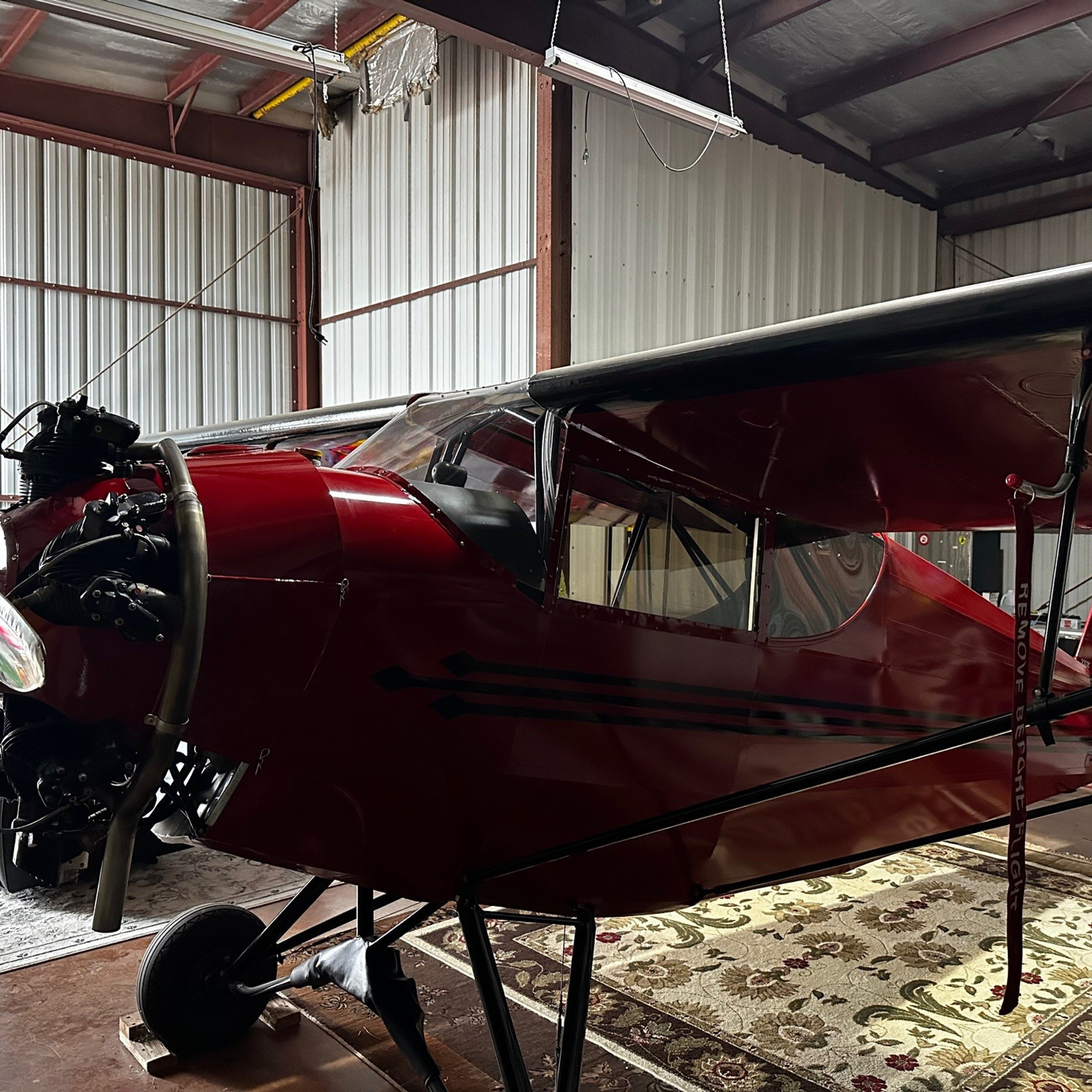
The Caldwell Collection at Mustang Field flies one of his company's engines. Our 1936 Porterfield 35-70 flies behind a LeBlond 5DF, certificated at 85 horsepower in 1930 and re-rated by LeBlond to 90 horsepower at 2,250 rpm in November 1936.