
The Founders' Tree
By Tony Caldwell, Founder and Chairman, The Caldwell Collection at Mustang Field
Spend enough time in the hangar with these airplanes and you start to notice family resemblances. A tail looks like a tail you saw two rows over. A landing gear has the same splay as one from a different factory in a different state. At some point I began to think about the fact that so many of the aircraft builders of the 1920s and 1930s knew each other or came from the same place, and once I started pulling on that thread, I couldn't stop. The three posters now hanging in the museum came out of that curiosity.
This is the story behind them.
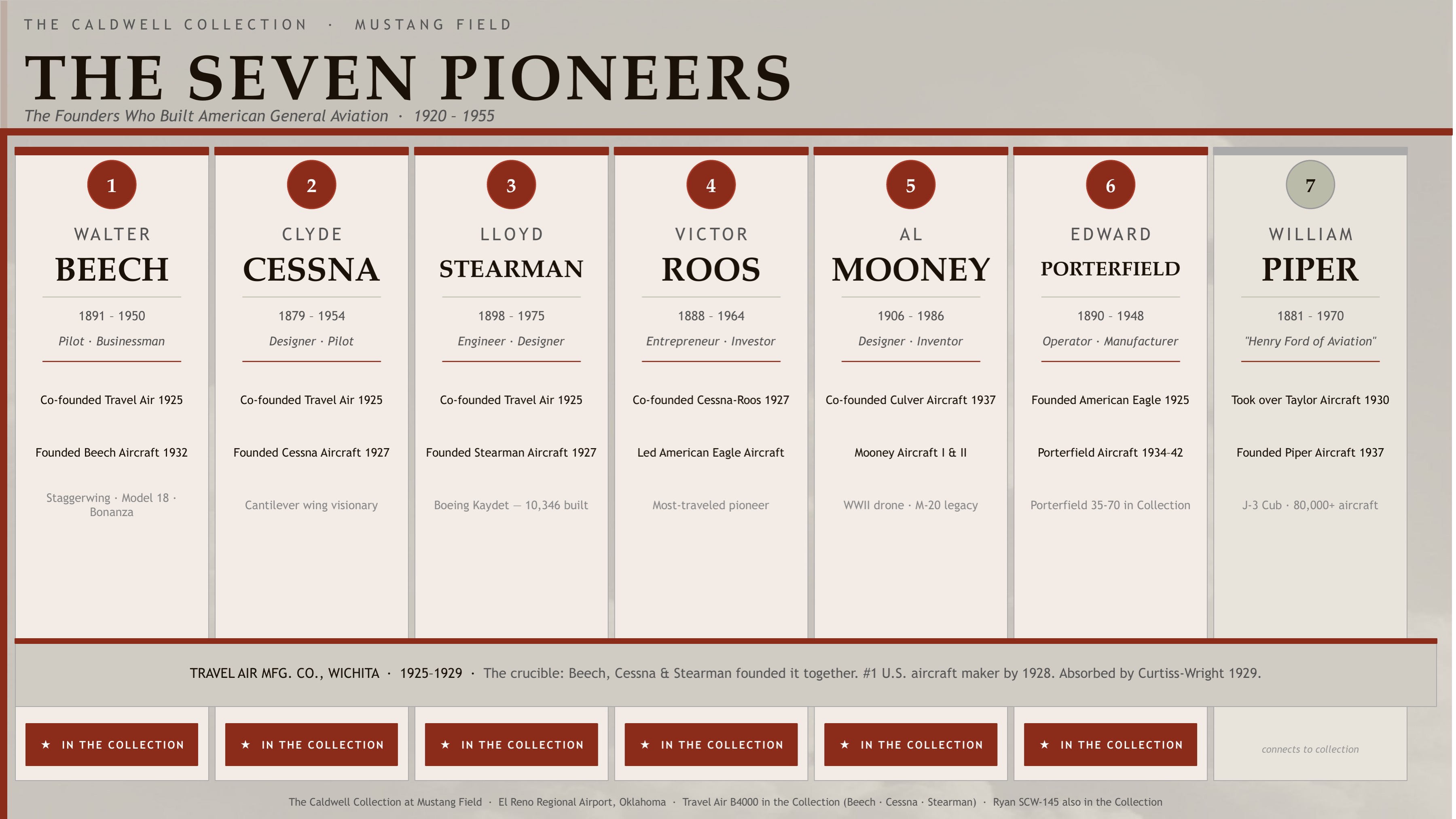
I started with the Swallow Airplane Company in Wichita, Kansas. Jake Moellendick was the founder, an oilman with money to spend and a conviction that Wichita should build airplanes. Now look at what came out of Swallow. Stearman, Beech and Roos all came from there. Lloyd Stearman was its engineer. Walter Beech sold and flew its airplanes. And after Moellendick went broke in 1927 and a group of Wichita businessmen bought the company, they hired Victor Roos to run it. And Clyde Cessna, who cofounded Travel Air a few years later was friends with Beech and Stearman. If you were going to draw a family tree of American general aviation, you could do a lot worse than putting Swallow at the root.
And if you think of Swallow as the root, you also have to think about Matty Laird. It was Laird's biplane that Moellendick bankrolled in 1920, the Laird Swallow, and it was Laird's shop that Stearman first walked into. Laird went home to Chicago and built Laird Aircraft into a maker of some of the fastest airplanes of the era. His Laird Solution won the Thompson Trophy in 1930, and Jimmy Doolittle flew a Laird Super Solution to win the first Bendix race in 1931. So the same small Wichita shop sent one man off to build racers and a handful of others off to build an industry.
Then you have to ask, well, where did those guys go? Beech, Cessna and Stearman go to Travel Air, which the three of them founded together in Wichita in 1925. When you look at the first Travel Air, the Model A that became the Travel Air 1000, you see echoes of the Swallow, and it is no wonder, because Stearman's hand was on both of them. By 1928 Travel Air was the largest aircraft maker in the country. Our 1927 Travel Air 3000 and 1929 Travel Air B4000 came out of that shop, and so did our 1931 Curtiss-Wright Travel Air B-14-R Speedwing, built after Curtiss-Wright bought the company in 1929.
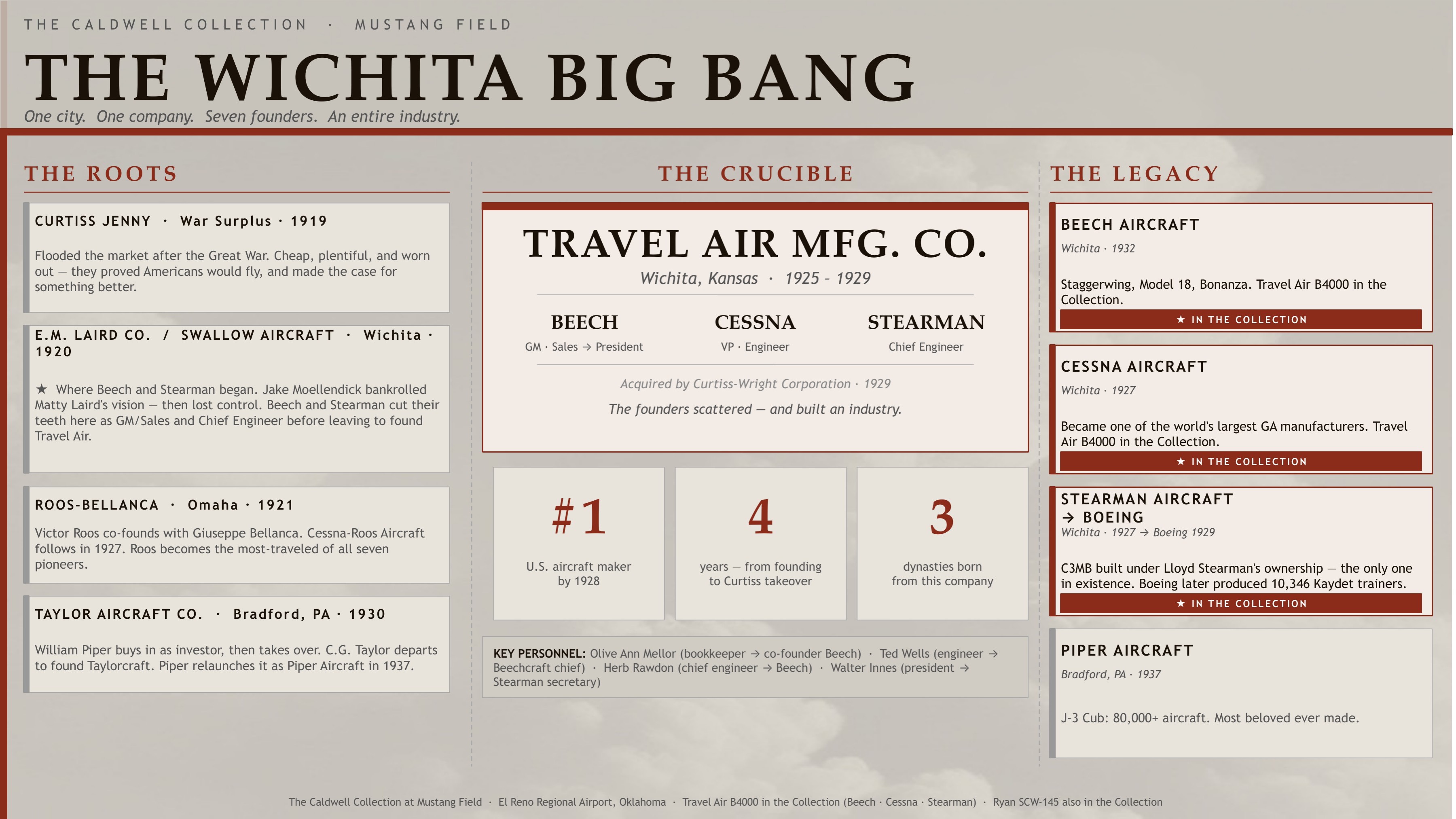
Out of Travel Air came the Cessna Aircraft Company, the Stearman Aircraft Company, the Boeing Stearman division and, of course, Beechcraft. Clyde Cessna left first, in 1927, and for a few weeks his new company was Cessna-Roos, with Victor Roos as his partner, before Roos sold his interest back and it became simply Cessna. Lloyd Stearman started his own company in California, came home to Wichita in 1927, and sold it to Boeing in 1929. Our 1928 Stearman C3MB is from Stearman's own years, and our 1942 Boeing-Stearman PT-17 is what that company became under Boeing, when it was turning out trainers for a war. Walter Beech stayed with Curtiss-Wright until a couple of years after selling to Curtiss Wright then, in 1932, he and Olive Ann Beech, who had started at Travel Air as the office manager, founded Beech Aircraft.
And not only Beechcraft. Though he didn't start it, Beech ends up owning the Culver Aircraft Company, which he and Charles Yankey took over in 1941. That brings up Al Mooney. Mooney started at Alexander Aircraft Company in Colorado, where he drew the Long Wing Eaglerock when he was barely out of his teens. He designed for a bunch of other people after that, designed the Culver Cadet, and then, after the war, owned his own company. It is one more thread in the same weave that his partner in Mooney Aircraft was that same Charles Yankey from Culver. Our 1928 Alexander Long Wing Eaglerock and 1940 Culver Cadet sit at either end of Mooney's prewar career like a pair of bookends.
Victor Roos may have traveled more of these roads than anyone. He goes on to Lincoln, Lincoln-Page and American Eagle, and when American Eagle and Lincoln-Page merged in 1931 as American Eagle-Lincoln at Fairfax Airport in Kansas City, Roos was its president. That matters to us directly, because our 1931 American Eagle Eaglet was built and sold new by that very company. Edward Porterfield is part of the same story. He starts at American Eagle, which he founded in 1925, draws the Eaglet there, and then goes on to Porterfield Aircraft under his own name. Our 1936 Porterfield 35-70 is the comeback. And when you look at our 1929 Lincoln-Page PT-W, you see echoes of the Swallow again.
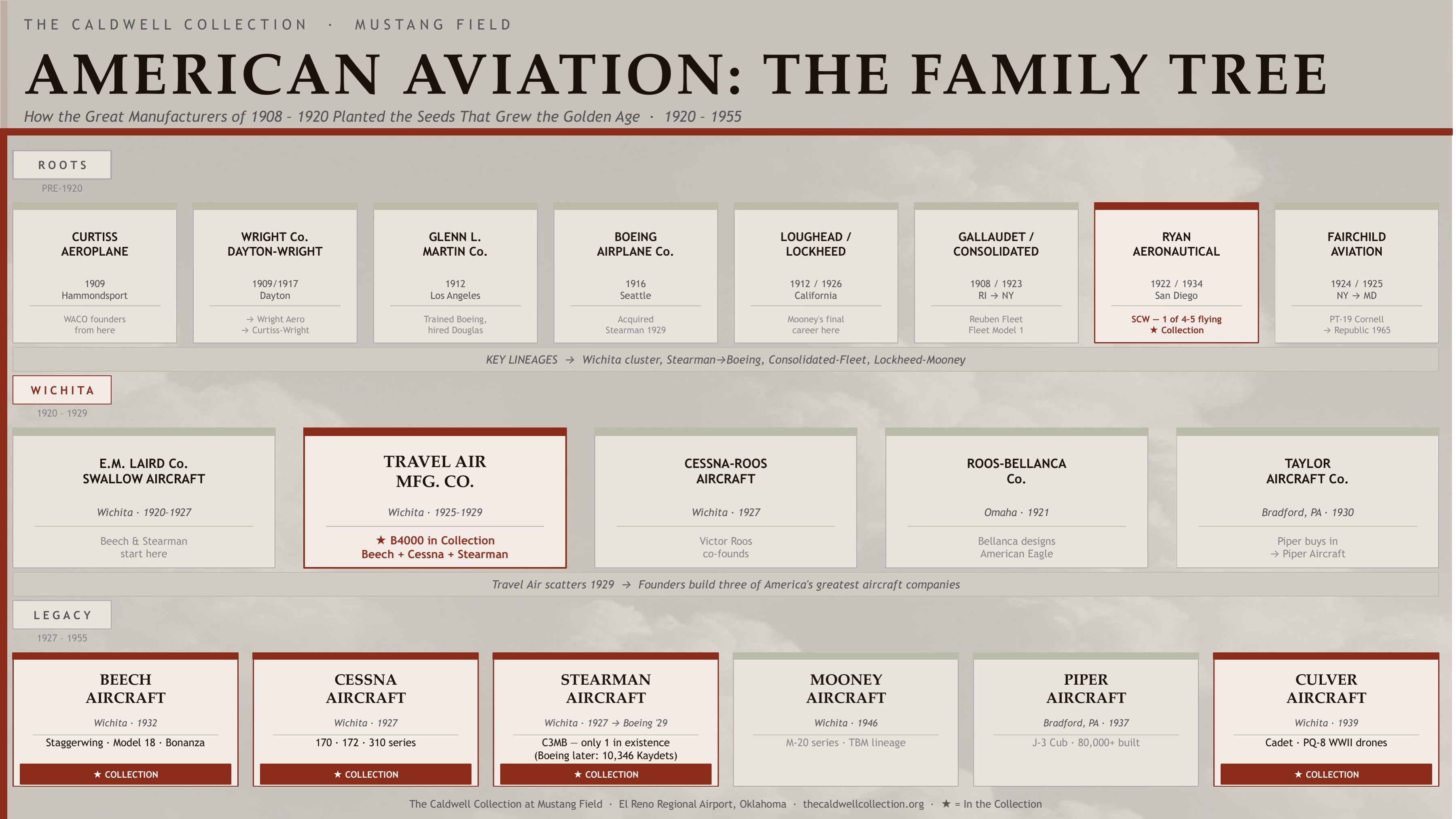
What strikes me most is that these people were building airplanes all over the country and still kept running into one another. William Piper and Clarence Taylor, and then ultimately Piper, were in Pennsylvania, where C.G. Taylor's little company became William Piper's, and Taylor went off to Ohio to start over, which is where our 1937 Taylor-Young Model A comes from. There was a big group in Wichita. And if you bring in Nicholas-Beazley in Marshall, Missouri, which built our 1932 Nicholas-Beazley NB-8G, and the Kansas City builders like Porterfield and Rearwin, there is a big nucleus right in the middle of the country.
Out on the West Coast you have T. Claude Ryan in San Diego, which built our 1938 Ryan SCW, along with Stearman for a time, Boeing of course, and others, all building similar airplanes. And they did more than build them side by side. They worked together, invested together, flew together in air races and air meets, and otherwise cross-fertilized each other's design ideas. A man who was your engineer one year might be your competitor the next and your investor the year after that. A good idea did not stay in one factory for long.
There are probably other iterations of this that I haven't thought about, and I hope some of you will tell me about them the next time you are in the hangar. But I find it fascinating that so many of these people knew each other and shared ideas. In many ways, the airplanes of the 1920s, and really into the 1930s, were less the product of a slide rule than of an imagination. And that imagination was powered by association, imitation, inspiration and competition.
The next time you visit, stand in front of the posters for a minute, then walk the hangar and look for the family resemblances yourself. Once you see them, you won't stop seeing them.
The airplanes in this story
- 1927 Travel Air 3000 NC1084
- 1928 Alexander Long Wing Eaglerock N5910
- 1928 Stearman C3MB N6487
- 1929 Lincoln-Page PT-W N561M
- 1929 Travel Air B4000 N13906
- 1931 American Eagle Eaglet 230 NC548Y
- 1931 Curtiss-Wright Travel Air B-14-R Speedwing N12311
- 1932 Nicholas-Beazley NB-8G N12518
- 1936 Porterfield 35-70 N326GH
- 1937 Taylor-Young Model A N19832
- 1938 Ryan SCW-145 NC18916
- 1940 Culver Cadet LCA N20988
- 1942 Boeing-Stearman PT-17 N67412
See all three posters full size on The Founders’ Tree exhibit page.